
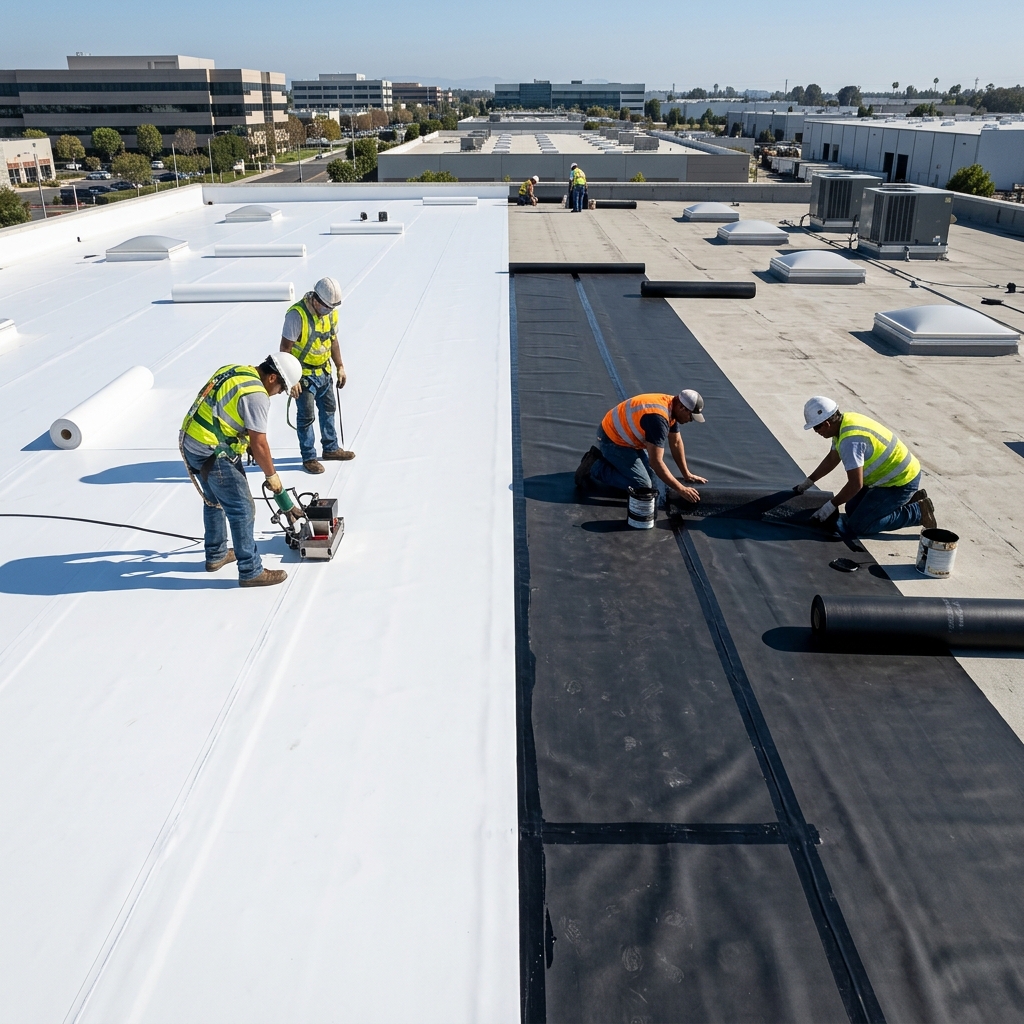
TPO vs. EPDM: Choosing the Best Flat Roof for Your Business
Why Your Commercial Flat Roof Choice Matters More Than You Think
Your commercial roof is one of the largest investments you’ll make in your property, and it directly impacts your bottom line. A failing roof leads to water damage, equipment loss, business interruption, and costly emergency repairs. Beyond protection, your choice of roofing material affects energy costs, insurance premiums, and how long before you need another replacement.
The decision between TPO and EPDM isn’t just about picking a material. It’s about understanding which system aligns with your building’s climate exposure, maintenance capacity, and long-term financial goals. Many property owners default to whatever their contractor recommends without understanding the real differences. We believe you deserve clarity on both options so you can make the choice that actually serves your business best.
Actionable takeaway: Before meeting with any roofing contractor, document your roof’s age, any leak history, and whether you prioritize upfront savings or long-term durability. This context will help you evaluate recommendations more confidently.
Understanding TPO Roofing: What Makes It Stand Out
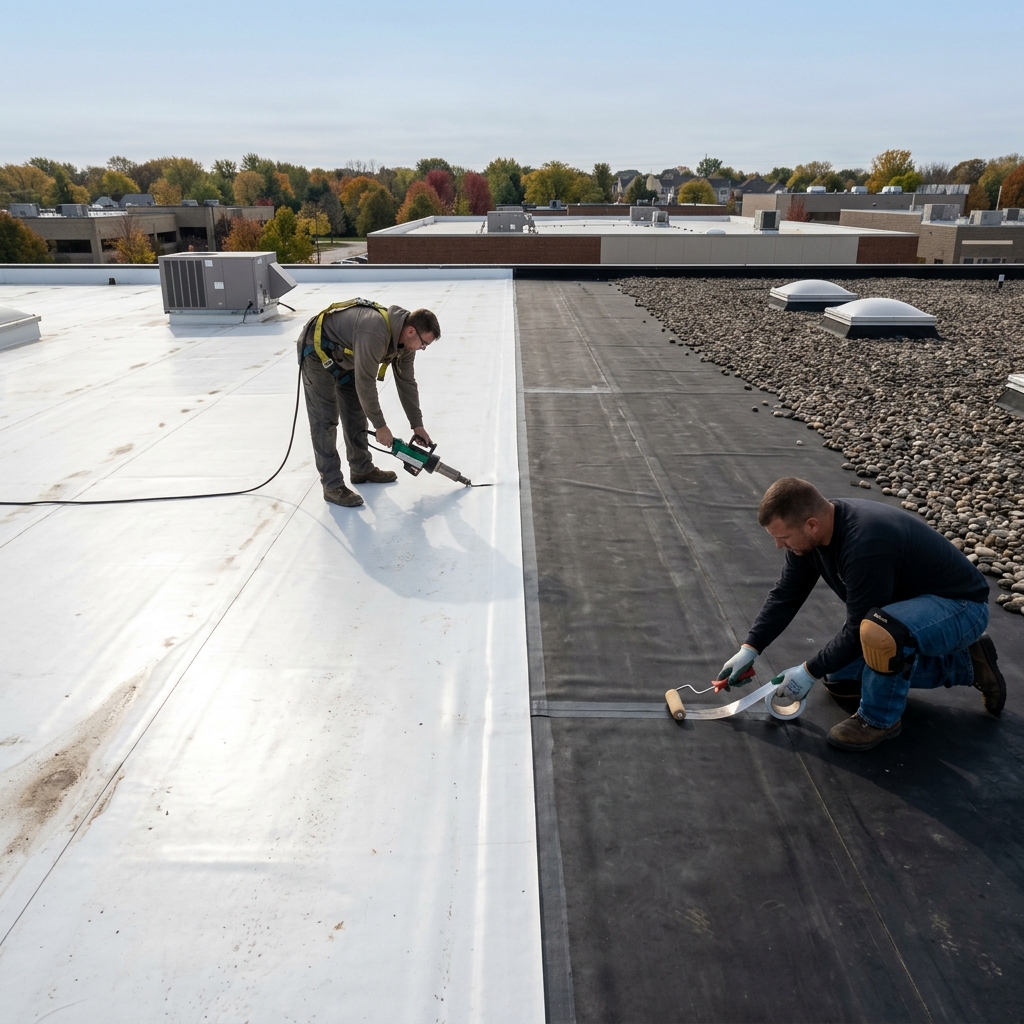
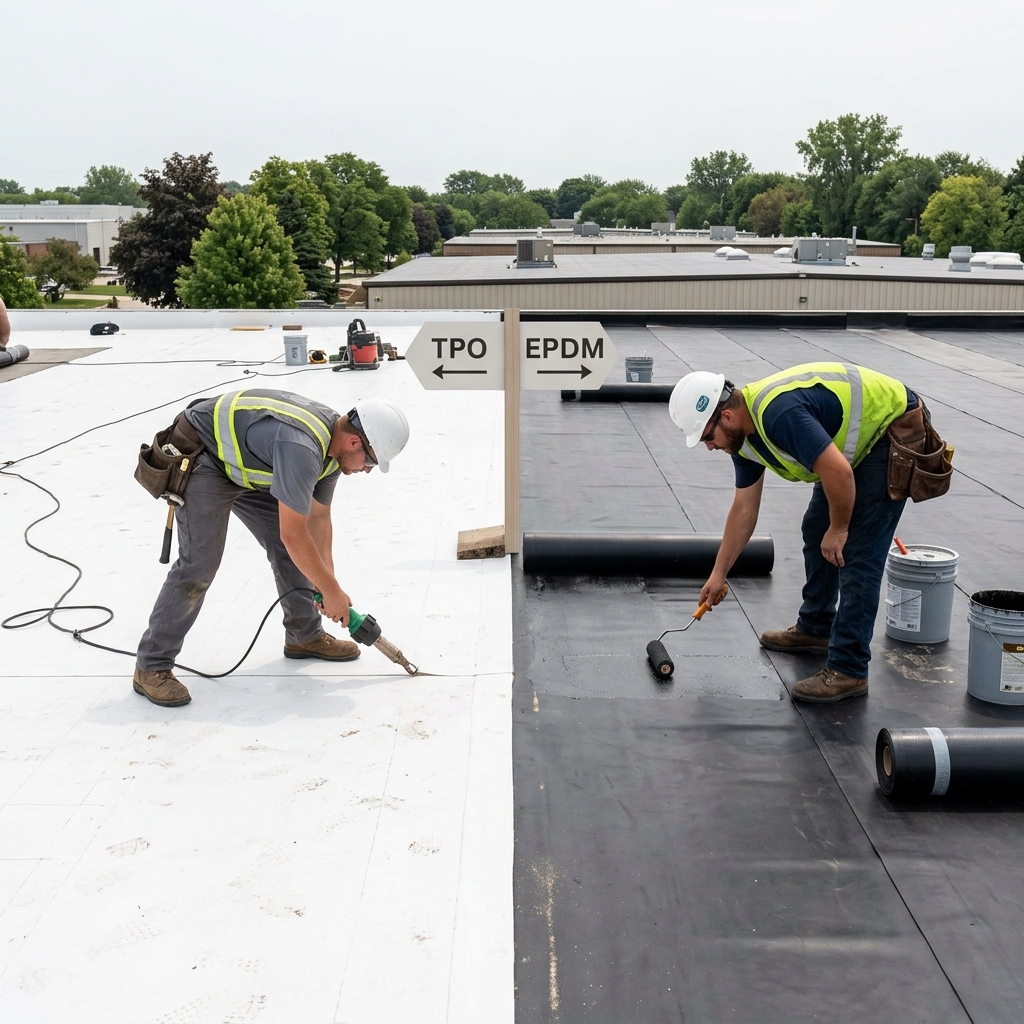
TPO (thermoplastic polyolefin) is a single-ply roofing membrane that has become increasingly popular in the last 15 years. It’s manufactured as a flexible sheet that we heat-weld together at the seams, creating a continuous, waterproof barrier. The material reflects a significant amount of sunlight, which gives it a built-in energy advantage.
What sets TPO apart is its chemical resistance and puncture tolerance. If a falling branch or foot traffic damages the membrane, TPO is easier to repair than EPDM because the heat-welded seams are more reliable under patch conditions. The material also resists UV degradation better than older rubber alternatives, meaning less brittleness over time.
TPO comes in light gray and white options, both of which amplify its reflectivity. We typically see energy savings of 10-15% compared to dark-colored roofs, which translates to real money on your cooling bills during Wisconsin’s humid summers.
The main consideration with TPO is installation quality. Poor seam welding or improper installation practices can lead to seam failures. This is why choosing an experienced contractor matters more with TPO than with some other materials.
Actionable takeaway: Ask any contractor about their TPO welding process, equipment, and installer certifications. Request references from commercial clients with TPO systems that have been in place for at least 10 years.
Understanding EPDM Roofing: Proven Durability and Performance
EPDM (ethylene propylene diene monomer) is a synthetic rubber roofing membrane that has been used commercially since the 1970s. It’s the grandfather of single-ply systems, and there’s extensive real-world performance data available. We’ve seen EPDM systems last 30+ years when properly maintained, with many still performing in the Brookfield area from installations decades ago.
The material is thicker and more puncture-resistant than TPO. If your roof faces regular foot traffic, equipment installation, or maintenance activity, EPDM’s durability in those scenarios is notable. It’s also more forgiving of installation variability. A less-than-perfect seam is still likely to perform adequately, whereas TPO seams require more precision.
EPDM uses a tacky adhesive or mechanical fasteners to secure seams rather than heat welding. This approach has proven itself over 50+ years of use. The rubber also remains flexible in cold temperatures, which is relevant here in Wisconsin. When temperatures drop, the membrane doesn’t become brittle or lose its waterproofing properties.
The trade-off is that EPDM absorbs more UV radiation than TPO, which means the material can degrade faster if exposed to intense sunlight without protective coatings. Additionally, the black rubber membrane absorbs heat, making it less energy-efficient than reflective TPO on cooling costs.
Actionable takeaway: EPDM makes sense if your building has significant roof traffic, if you’re budget-conscious upfront, or if you prioritize proven longevity over energy savings.
Cost Comparison: TPO vs. EPDM Installation and Materials
Material costs tell only part of the story. TPO membrane typically costs 10-20% more per square foot than EPDM when you compare equivalent quality products. Labor costs are roughly comparable for both systems, though TPO installation may take slightly longer because proper heat welding requires more precision and skill.
For a typical 10,000 square foot flat roof in Brookfield, the material difference might range from $2,000 to $4,000 in TPO’s favor when starting fresh. However, long-term operating costs shift the equation. TPO’s superior reflectivity means lower cooling costs year after year. Over a 20-year cycle, those energy savings can total $8,000 to $15,000 depending on your local electricity rates and roof exposure.
Maintenance costs also differ. EPDM typically requires sealing and coating maintenance every 5-10 years, which costs $500 to $1,500 per application for a mid-sized roof. TPO requires less preventive maintenance because the material resists UV degradation more effectively. This advantage compounds over time.
If you’re viewing this decision purely on upfront installation cost, EPDM wins. If you’re calculating total cost of ownership over 20-30 years, TPO often comes out ahead due to energy efficiency and lower maintenance frequency.
Actionable takeaway: Request itemized quotes from your roofing contractor that separate material costs, labor, and projected maintenance. This makes the true economic comparison transparent.
Longevity and Maintenance: Which Material Wins Over Time
EPDM’s expected lifespan is 25-30 years with proper maintenance. The key word is “maintenance.” Regular inspection, prompt patching of small damage, and protective coatings applied every 5-10 years extend the roof’s life and protect your investment. When we work with EPDM systems, we recommend annual inspections to catch issues early.
TPO roofs, when properly installed by experienced crews, typically last 20-25 years. Some data suggests TPO can reach 30+ years, but the material hasn’t been in widespread use long enough to establish clear consensus. The seam quality is the critical variable. A TPO roof with excellent welding will outlast one with marginal seam work by a decade or more.
Both materials will eventually require replacement. The question is whether your building’s timeline and budget accommodate proactive replacement on schedule, or whether you’re hoping to stretch an aging roof beyond its prime. An aging roof typically costs more to maintain, and the risk of catastrophic failure increases.
EPDM’s long track record in Wisconsin’s freeze-thaw cycle is well-established. Roof failures are rare when the system was installed correctly and maintained. TPO’s performance through multiple Wisconsin winters is still being documented, though early results are strong.
Actionable takeaway: Establish a roof maintenance schedule within the first year of installation. Document inspections and repairs. This record protects your insurance coverage and helps you budget for replacement before emergency situations develop.
Energy Efficiency and Weather Resistance: Your Bottom Line Protection
Roof surface temperature is the silent driver of building energy costs. On a 95-degree day, an EPDM roof reaches 160+ degrees, while a white TPO roof often stays below 130 degrees. That difference in heat absorption directly reduces cooling system load and utility bills.
For commercial buildings with significant air conditioning demand, the energy advantage of TPO is measurable and immediate. We’ve reviewed utility bills for clients before and after TPO installation, and the cooling cost reduction is consistent. Over 20 years, this advantage adds up to meaningful dollars.
Weather resistance differs subtly. Both materials handle rain, snow, and freeze-thaw cycles effectively when installed correctly. However, TPO’s reflectivity provides a secondary benefit: it reduces thermal stress on the membrane. Less expansion and contraction means fewer chances for seams to separate or fasteners to pull loose.
EPDM’s rubber composition actually provides excellent flexibility during temperature swings. The material doesn’t become rigid in cold. This makes it particularly suited to Wisconsin’s extreme seasonal temperature variations, where daily swings of 30-40 degrees aren’t uncommon.
Neither material is inherently superior in weather resistance. The real variable is installation quality and how well the system handles thermal stress over time.
Actionable takeaway: If energy efficiency is a priority, TPO’s reflectivity difference is worth the slight upfront cost premium. Request a utility projection from your contractor based on your building’s exposure and local energy rates.
Our Proven Approach to Selecting Your Ideal Flat Roofing System
We don’t believe in one-size-fits-all recommendations. Our approach starts with understanding your specific situation: How old is your current roof? What’s your building’s use and occupancy? Will you occupy this building for the next 20 years, or might you sell within 5-10 years? What’s your maintenance culture like?
We perform a roof inspection and assess structural condition, drainage patterns, and any existing issues. If your roof has underlying water damage or deck deterioration, we address that before installing new membrane. A new roof on a damaged deck is like putting new tires on a car with a bent frame.
We then discuss the TPO vs. EPDM question in context of your answers. If you’re planning to hold the property long-term and prioritize efficiency, TPO typically makes sense. If budget is tight and you value proven reliability, EPDM serves well. Some commercial clients with multiple buildings choose different systems for different properties based on their specific characteristics.
We also discuss warranty protection. Our roofing systems come with 15-year workmanship warranties, which means you’re protected against installation failures. This warranty applies to both TPO and EPDM installations, giving you assurance regardless of which material you choose.
Actionable takeaway: Schedule a roof assessment with a contractor who explains both options without pushing you toward one. Your questions about maintenance capacity and building timeline should be driving the recommendation, not the contractor’s preference.
How We Install Your New Commercial Roof for Maximum Performance
Installation quality determines whether you get a 20-year roof or a 30-year roof from the same material. We train our crews on the specific requirements of each membrane type. For TPO, that means ensuring seam temperatures are precise, seam strength meets factory specs, and every weld is visually inspected. We use infrared testing to verify seam integrity before we consider the job complete.
For EPDM, our focus is on proper fastener spacing, adhesive application, and protective coating application. We follow manufacturer guidelines exactly, and we don’t cut corners on labor-intensive steps like primer application or seam overlap setup.
Both installation approaches require proper substrate preparation. If your existing roof is in poor condition, we remove it entirely rather than installing new membrane over compromised decking. The added cost of removal and disposal prevents future problems that would be far more expensive to address.
We perform a final walkthrough with you, documenting the installation with photos and explaining your maintenance responsibilities going forward. This documentation becomes part of your building’s record and supports your insurance coverage.
Actionable takeaway: Request a detailed installation timeline and plan to have rooftop access ready for our crew. Ask about weather delays and what the contractor’s backup plan is for wet conditions, which impact both TPO welding and EPDM adhesive application.
Why Expert Exteriors is Your Trusted Partner for Flat Roof Solutions
We’ve been serving Brookfield and surrounding areas with commercial roofing solutions for years. We understand Wisconsin’s climate, the specific challenges that flat roofs face in our region, and what long-term performance actually looks like. We’re not just installers; we’re your long-term partner in protecting your building.
We’ve worked on both TPO and EPDM systems extensively, and we have the certifications and equipment to install both at the highest standard. Our crews are trained annually on the latest best practices, and we stay current with changes in materials and installation techniques.
When you choose Expert Exteriors, you’re choosing a company that warranties its work, stands behind installations, and views your roof as the critical asset it is. We work with you to understand your goals, assess your roof honestly, and recommend the solution that truly serves your business best, not just our margin.
We also offer instant roof replacement quotes so you can understand costs upfront without pressure. We’re transparent about materials, labor, and long-term expectations.
If you’re deciding between TPO and EPDM for your commercial building, we’d welcome the chance to assess your roof, discuss your priorities, and provide a recommendation you can trust. Contact us today to schedule a professional roof evaluation.