
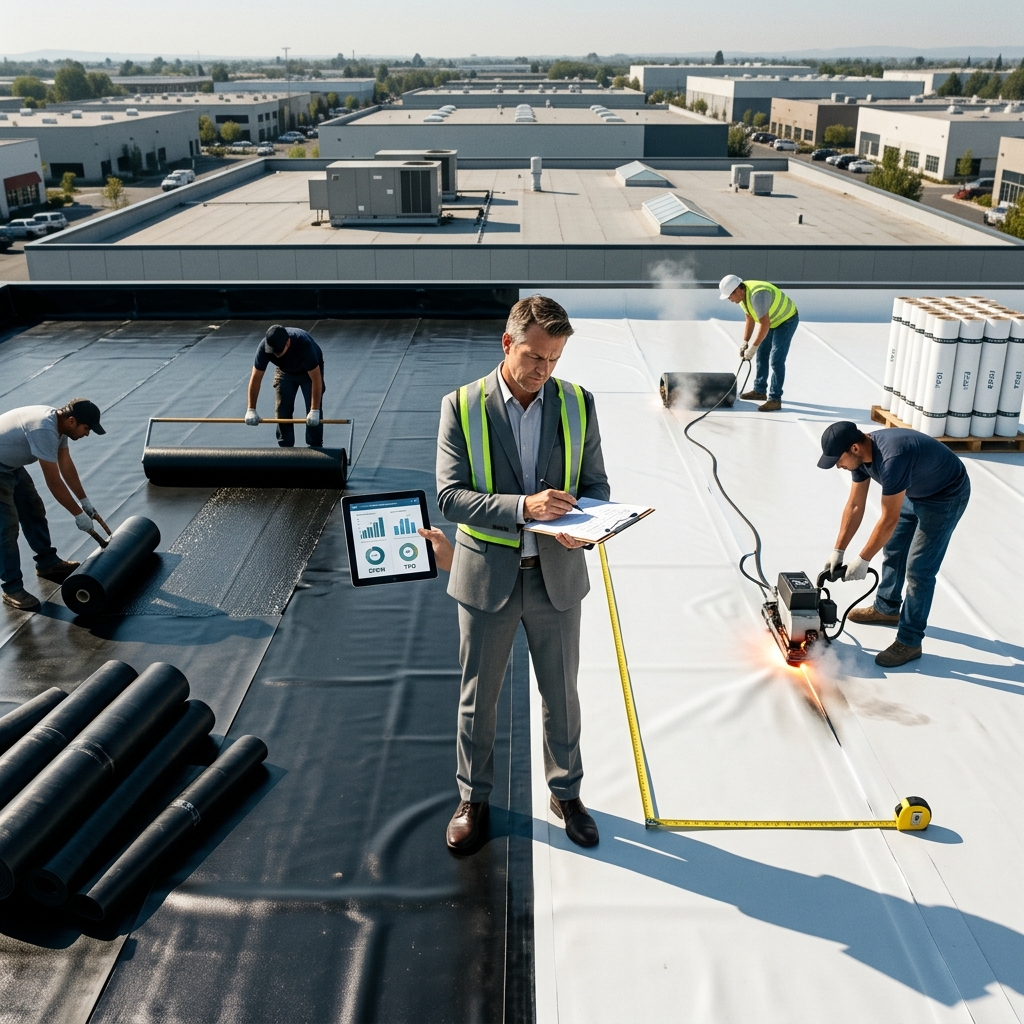
EPDM vs TPO: Choosing the Right Flat Roofing System for Your Commercial Property
Understanding Your Commercial Roofing Dilemma
Your commercial roof is one of your biggest assets, yet it’s easy to overlook until problems start costing you money. If you’re facing a roof replacement decision for a flat or low-slope commercial property, you’ve likely encountered two names repeatedly: EPDM and TPO. Both are excellent single-ply membrane systems, but they’re fundamentally different materials with distinct advantages depending on your property’s needs.
The stakes are real. A roof failure doesn’t just mean water damage to your building—it means operational disruption, tenant complaints, potential liability, and unexpected capital expenses. Choosing between EPDM and TPO isn’t a minor detail. The right choice protects your investment for decades while keeping energy costs predictable. The wrong choice might save you money upfront but cost significantly more over the roof’s lifetime.
We work with commercial property owners across Brookfield and surrounding areas who face this exact decision. After years of installing and managing both systems, we’ve learned what works best in different scenarios. This guide walks you through the practical differences so you make a decision based on facts, not marketing claims.
What is EPDM Roofing and How It Works
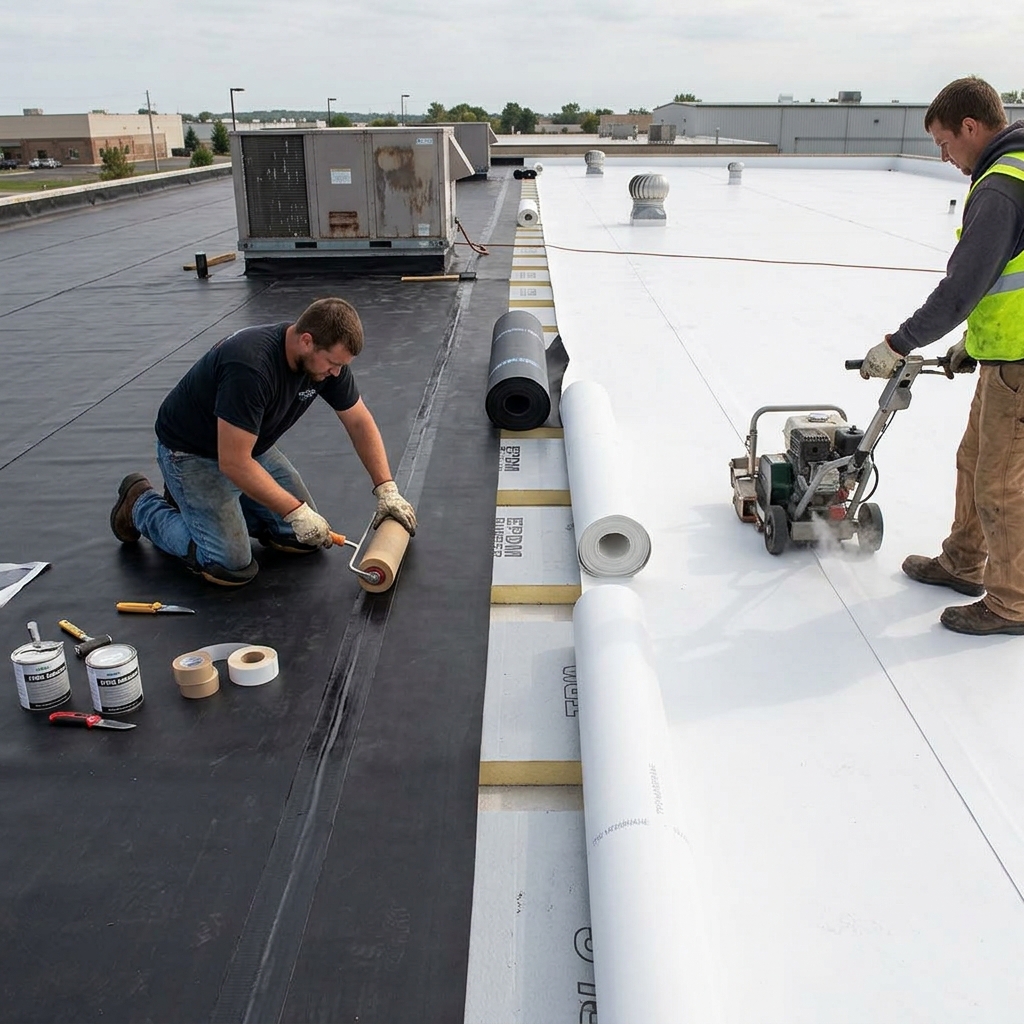
EPDM stands for ethylene propylene diene monomer. Think of it as a synthetic rubber material that’s been the standard for flat commercial roofing since the 1970s. It comes in large sheets that are either mechanically fastened or adhered to your roof deck, with seams sealed using specialized tape or liquid adhesives.
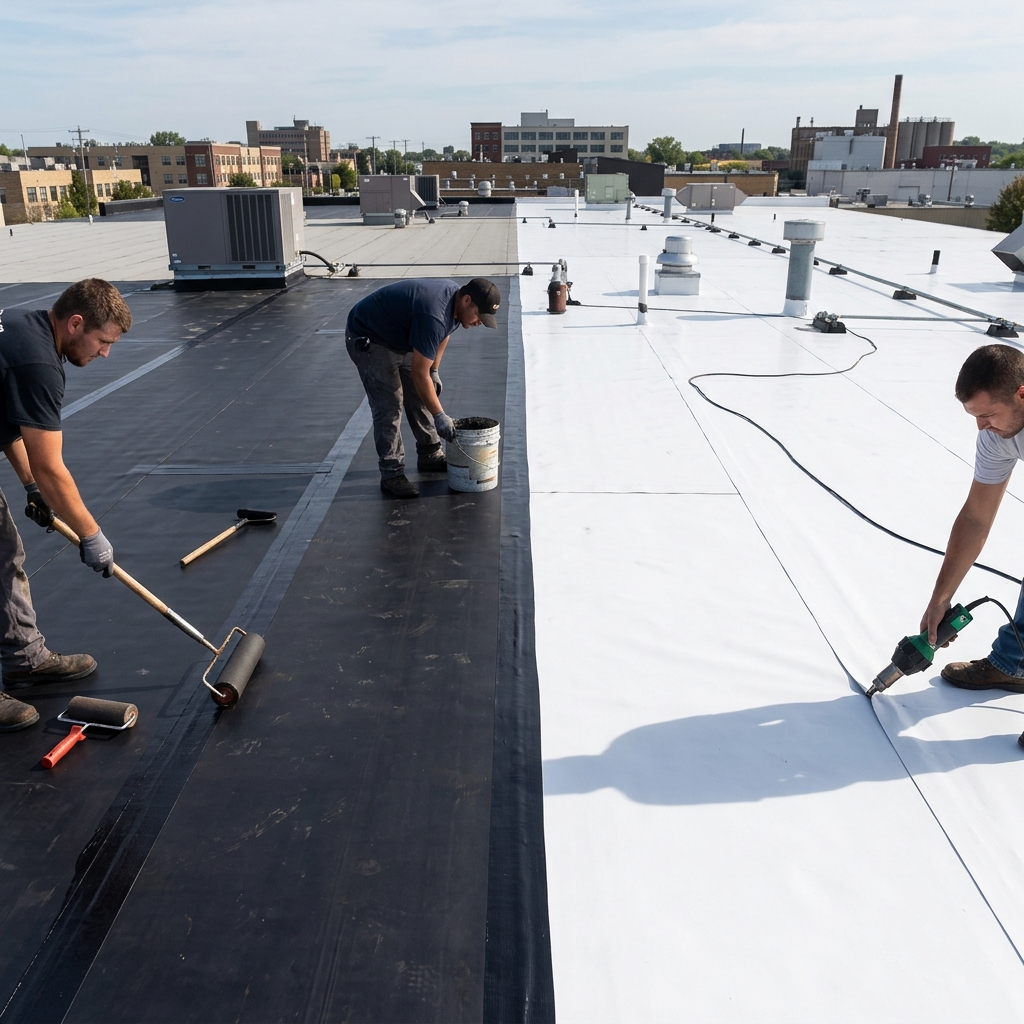
EPDM has a distinctive black appearance (though white versions exist), and that dark color is actually one of its defining characteristics. The material remains flexible even in cold temperatures, which matters considerably in Wisconsin winters. It’s also remarkably durable when properly installed, resisting UV degradation better than many people assume. The rubber composition allows it to expand and contract with temperature swings without cracking or becoming brittle.
The installation process involves rolling out massive sheets across your roof and seaming them together. The seams are the critical point—poor seam work leads to leaks, while proper seaming creates a reliable waterproof barrier. We prioritize seam quality above all else during EPDM installation because that’s where the system succeeds or fails.
One advantage many property owners appreciate: EPDM repair is straightforward. If you develop a small puncture or tear, patching it is simple and inexpensive. The material’s forgiving nature means minor damage doesn’t necessarily require costly intervention.
What is TPO Roofing and How It Performs
TPO stands for thermoplastic polyolefin, a more modern membrane system that gained significant market share over the past two decades. Unlike EPDM’s rubber composition, TPO is a plastic-based material—specifically a blend of polypropylene, ethylene-propylene rubber, and other compounds.
TPO sheets are white by default, which matters for energy efficiency. The white surface reflects sunlight rather than absorbing it, keeping your roof cooler and reducing cooling costs. TPO sheets are heat-welded together at seams using specialized equipment and trained technicians. The heat-welded seams create a continuous bond that’s theoretically stronger than EPDM’s adhesive or tape-based seams.
TPO installation is more technique-sensitive than EPDM. The quality of the heat-welding process directly impacts the membrane’s reliability. Improper welding temperatures, speed, or technique creates weak seams. This is why installer experience matters tremendously with TPO systems.
The material itself is stiffer than EPDM, especially in cold weather. This can actually be an advantage in some applications because it’s less prone to ponding (standing water pooling on the roof). However, the reduced flexibility in Wisconsin winters means expansion and contraction stress is handled differently by the material itself rather than by flexibility.
Durability and Longevity Comparison
Both EPDM and TPO can easily last 20-25 years with proper maintenance and installation. That’s the headline, but the nuances matter for your decision.
EPDM has the longer track record. Roofs installed 40+ years ago are still functioning well today. The material has simply proven itself over decades. We’ve inspected 30-year-old EPDM roofs in excellent condition, with seams still holding strong. The rubber’s inherent flexibility helps it handle the freeze-thaw cycles Wisconsin experiences without degrading.
TPO’s longevity story is shorter because the material hasn’t been around as long. Most TPO roofs performing at 25 years today were installed in the early 2000s. Early TPO formulations (1990s-2000s) actually showed some durability issues with UV degradation and seam failures. Modern TPO is significantly improved, but we simply don’t have 40-year-old TPO roofs to study yet.
Where TPO excels is consistency. Properly heat-welded seams create fewer weak points than EPDM’s tape or adhesive seams. Factory-controlled TPO membranes also have more consistent composition than EPDM, which varies slightly between manufacturers and batches.
The real-world difference in our experience: EPDM requires expert seaming to achieve high reliability; TPO requires expert installation but delivers more predictable results once it’s installed correctly. Neither wins this category outright—the winner depends on your installer’s competence.
Cost Analysis: Installation and Long-Term Value
EPDM typically costs less to install. The material itself is cheaper, and the installation process is less equipment-intensive. On a 10,000 square foot commercial roof, EPDM installation might run $0.75-$1.25 per square foot installed, while TPO typically ranges from $1.00-$1.75 per square foot installed.
For a 10,000 square foot roof, that’s potentially a $2,500-$7,500 difference in upfront cost. That matters to property owners evaluating their capital budget. EPDM’s lower cost has made it attractive for budget-conscious decisions for decades.
However, upfront cost isn’t the whole story. TPO’s superior reflectivity reduces cooling costs by 10-30% depending on your climate and cooling system. In Wisconsin, those savings are meaningful but not dramatic. Over a 25-year roof lifespan, energy savings might total $5,000-$15,000 depending on your building’s cooling load and electricity costs.
Maintenance and repair costs often differ between the two systems. EPDM repairs are cheaper but slightly more frequent. TPO repairs are pricier but typically less frequent thanks to more reliable seams. Over the roof’s lifetime, this might net out to similar total costs.
Our analysis shows EPDM makes more financial sense for property owners prioritizing lowest initial investment. TPO makes sense for owners who plan to occupy the building long-term and want to maximize energy efficiency and minimize maintenance disruption. The choice hinges on your timeline and priorities.
Energy Efficiency and Environmental Impact
TPO’s white reflective surface is a genuine advantage for cooling costs. The high solar reflectance (typically 0.65-0.75) means your roof absorbs far less heat compared to EPDM’s dark surface. In summer months, this translates to noticeably lower air conditioning loads.
EPDM’s black surface absorbs heat, increasing cooling demands. However, in winter, that absorbed heat is essentially wasted since commercial buildings are heated from within. The net energy benefit favors TPO in most climates, including Wisconsin.
Environmentally, both materials are recyclable to some degree. TPO recycling infrastructure is developing but still limited. EPDM has better established recycling programs through rubber recovery initiatives. Neither system is ideal from a sustainability standpoint, though both are better than traditional asphalt-based roofing.
The manufacturing impact slightly favors TPO—the process generates fewer emissions than EPDM production. However, this advantage is modest and unlikely to be a deciding factor for most property owners.
If energy efficiency and environmental responsibility rank highly on your property’s values, TPO edges ahead. For purely economic considerations, the energy savings don’t typically justify TPO’s higher cost unless you’re in a very hot climate.
Maintenance Requirements and Repair Costs
EPDM requires regular inspections, particularly around seams and penetrations where water finds weak points. Debris accumulation is less critical since the material tolerates standing water better than TPO. However, we recommend clearing your roof of leaves and branches semi-annually to prevent future problems.
EPDM repairs involve patching with the same material. A 1-2 foot patch costs $100-$300 in labor and materials. Larger repairs or failed seams might run $500-$2,000 depending on the damage extent. The material’s forgiving nature means small damage rarely becomes catastrophic.
TPO requires more fastidious maintenance, particularly regarding water management. Ponding water (even small amounts) accelerates degradation. Regular cleaning is more critical. The payoff: seam failures are less common, so major repairs happen less frequently.
TPO repairs are pricier because heat-welding requires specialized equipment and certified technicians. A comparable patch costs $150-$400, and seam work runs $800-$2,500 depending on the seam length and location.
Our recommendation: Choose EPDM if you’re comfortable with semi-annual maintenance and proactive minor repairs. Choose TPO if you prefer longer intervals between repairs and have budget for higher repair costs when they occur. Factor your building’s maintenance culture into this decision.
Climate Suitability for Wisconsin Properties
Wisconsin’s climate strongly influences this decision. Our winters are genuinely cold, with temperatures regularly dropping below zero and freeze-thaw cycles occurring 30-50 times annually. Our summers are warm but not extreme.
EPDM thrives in this environment. The material’s flexibility in cold temperatures is a genuine advantage. Freeze-thaw cycling creates expansion and contraction stress on roof membranes. EPDM’s rubber composition handles this gracefully—it flexes rather than stresses. We’ve inspected 35-year-old EPDM roofs installed by other contractors that are still functioning well.
TPO’s reduced flexibility in cold temperatures is a potential concern. While modern TPO is engineered for cold climates and performs adequately, it simply handles extreme temperature swings differently than EPDM. The material’s stiffness in winter might create microscopic stresses at seams and penetrations.
Wisconsin’s moderate summer temperatures also mean TPO’s cooling advantage is modest. You won’t see dramatic energy savings here like you would in Arizona or Texas.
For Wisconsin commercial properties specifically, EPDM is the climate-optimized choice. TPO certainly works here—many buildings have successful TPO roofs—but EPDM’s material properties align more naturally with our winters.
Our Expert Assessment and Recommendation
After installing hundreds of flat and low-slope roofs across Wisconsin, our recommendation is straightforward: EPDM is the superior choice for most Wisconsin commercial properties.
Here’s why: EPDM’s material flexibility handles our climate’s temperature extremes better. EPDM’s installation and repair simplicity means fewer things go wrong over the roof’s 25-year lifespan. EPDM’s lower cost either reduces your capital expense or provides budget for additional quality assurance. EPDM’s proven 40+ year track record means we know exactly how it behaves in decade-by-decade real-world conditions.
TPO makes sense in specific scenarios: if you have aggressive cooling demands (data centers, heavily used commercial kitchens), if you’re maximizing long-term energy efficiency for a 30+ year occupancy, or if you’re partnering with an installer whose TPO expertise is exceptional. For most property owners, TPO’s advantages don’t justify its higher cost in our climate.
The critical factor regardless of which you choose: work with an installer who treats seaming or heat-welding as the non-negotiable quality standard. That’s where both systems succeed or fail. We don’t cut corners on these details, which is why our roofing projects consistently outperform industry averages for lifespan and performance.
Why Expert Exteriors is Your Ideal Choice
We’ve positioned ourselves as Wisconsin’s trusted commercial roofing specialists because we treat every installation as if it’s protecting our own business. Here’s what sets our approach apart:
We recommend based on your property’s specific needs, not on which system generates higher margins. That honesty builds trust and ensures you’re making the right decision for your situation. We don’t favor EPDM because it’s cheaper or TPO because it’s fancier—we recommend based on climate, budget, usage, and timeline.
Our installation teams are certified and extensively trained on both systems. More importantly, we hold ourselves to exacting standards on every seam or weld. We inspect our own work during installation and again before project closeout. We photograph and document quality checkpoints so you have proof of proper installation.
We back our work with 15-year workmanship warranties on full roof replacements. That commitment means we stand behind our installations completely. If something goes wrong within that warranty period due to our installation, we fix it at no cost.
We’re local, which matters for ongoing maintenance and emergency repairs. When your roof leaks at 2 AM, you can reach us. We know the Brookfield area’s specific weather patterns and property types, so our recommendations are based on local experience, not generic guidance.
Our project timeline is realistic. We don’t rush installations to hit arbitrary schedules. Proper seaming or heat-welding takes the time it takes—rushing this phase compromises the roof’s reliability.
Getting Started with Your Commercial Roof Replacement
The first step is a professional roof assessment from someone who has no financial incentive to recommend unnecessary replacement. We evaluate your current roof’s condition, identify remaining lifespan, and honestly assess whether replacement is needed now or can wait.
If replacement is warranted, we discuss your property’s specific factors: budget timeline, expected occupancy duration, cooling demands, maintenance commitment, and climate exposure. This conversation—not a generic questionnaire—informs our recommendation between EPDM and TPO.
We then provide a detailed quote specifying materials, installation method, timeline, and warranty terms. Our quotes are transparent—no hidden costs or confusing line items. You’ll understand exactly what you’re paying for and why.
Once you move forward, we schedule your project and manage every phase from material procurement through final inspection. We communicate progress regularly and address any questions or concerns immediately.
Ready to move forward? Get an instant roof replacement quote to start the conversation. Or contact us directly if you’d like to discuss your specific situation with one of our roofing specialists. We’re here to help you make the right choice and execute it flawlessly.
Your commercial roof protects everything inside it. That deserves expert attention, quality materials, and honest guidance. That’s exactly what we deliver.