
Commercial TPO vs. EPDM Roofing: Which System Protects Your Business Best
The Commercial Roofing Decision Property Owners Face
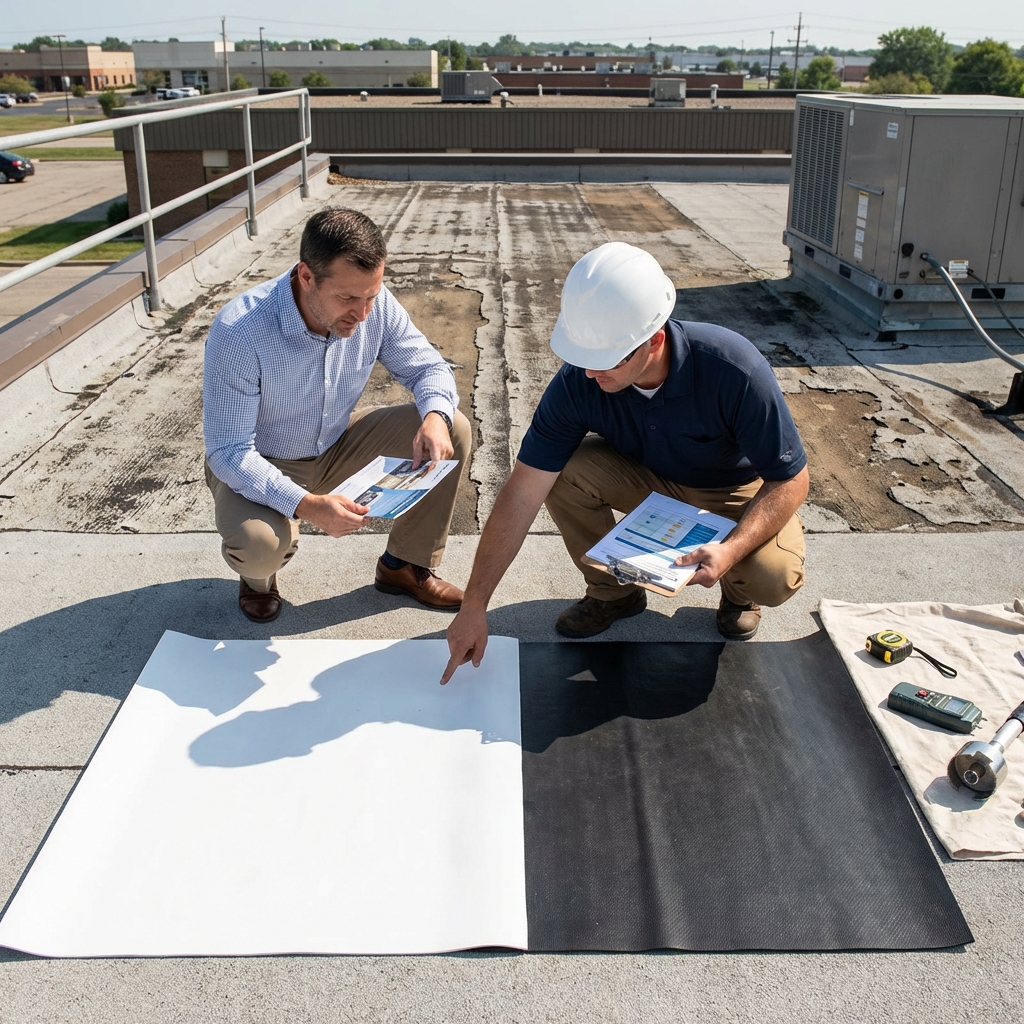
When your commercial roof reaches the end of its life, you face a choice that directly impacts your bottom line, operational safety, and property value. TPO and EPDM are the two dominant membrane systems for flat and low-slope roofs, and they’re not interchangeable. The wrong choice costs you tens of thousands in premature repairs or inadequate performance during Wisconsin weather extremes.
Most property owners don’t realize how much their roofing material affects energy costs, insurance premiums, and maintenance budgets over the next 15 to 25 years. We’ve watched business owners rush into decisions based solely on upfront price, only to face accelerated degradation, seam failures, and weather damage that a different system would have prevented.
Here’s what makes this decision complex: both TPO and EPDM work. The question isn’t whether they’ll keep water out (both will, when installed correctly). The question is which system delivers better value, durability, and peace of mind for your specific property and budget over its entire lifespan. We’re here to walk you through the real differences so you can choose with confidence.
Understanding TPO Membrane Technology and Benefits
TPO stands for thermoplastic polyolefin, and it’s a single-ply membrane that’s been refined over decades. Think of it as a engineered plastic sheet designed specifically for roofing stress. The material is manufactured as a homogeneous layer with built-in flexibility, which matters when Wisconsin temperature swings make your roof expand and contract.
What makes TPO appealing to us and our clients is its reflectivity. TPO membranes are light-colored by nature, which bounces solar heat away from your building. During summer months, this reduces your cooling load noticeably. We’ve seen commercial properties save 10-15% on HVAC costs just by switching to TPO, especially if they’re replacing older dark roofing.
The seams on TPO are heat-welded, not glued. Our crews use specialized equipment to melt the edges of two TPO sheets together, creating a bond that’s actually stronger than the membrane itself. This heat-welded approach eliminates the long-term adhesive degradation risk that comes with glued systems. Over 20 years, this makes a real difference in seam integrity.
TPO also responds well to punctures and foot traffic. The material has some give to it. If someone drops a tool or walks the roof during maintenance, TPO is more forgiving than some alternatives. That said, it’s not invulnerable, and proper maintenance still matters.
What to do next: If your building has significant sun exposure and you’re concerned about cooling costs, TPO’s energy efficiency makes immediate financial sense.
Understanding EPDM Rubber Roofing Characteristics
EPDM is ethylene propylene diene monomer, a synthetic rubber membrane that’s been protecting commercial roofs since the 1960s. It’s thicker than TPO (typically 45 or 60 mil), which some contractors and owners interpret as “more durable.” The reality is more nuanced.
EPDM’s rubber composition gives it exceptional flexibility. In the harsh Wisconsin freeze-thaw cycles, EPDM stays pliable when TPO becomes slightly less forgiving at extreme cold temperatures. This flexibility is genuine protection against thermal stress cracking. If your roof experiences dramatic temperature swings, EPDM’s rubber elasticity is a real asset.
The dark color of traditional EPDM is its trade-off. Black rubber absorbs solar heat, which increases cooling demands. However, manufacturers now offer white reflective EPDM coatings that reduce this advantage. Still, choosing reflective EPDM adds cost and ongoing maintenance because the white coating requires periodic recoating to maintain reflectivity (typically every 5-10 years).
Seams on EPDM use adhesive, not heat welding. We apply specialized glues along the overlapping edges. These adhesive seams are reliable when applied correctly, but they depend on the adhesive maintaining its bond over decades. Climate, UV exposure, and the quality of the original application all influence how those seams perform long-term.
EPDM has proven longevity in northern climates. Thousands of Wisconsin roofs installed 30+ years ago are still functioning. That track record carries weight, especially for risk-averse property owners.
Cost Comparison: Initial Installation and Long-Term Value
This is where many property owners make their decision, and we want you to see the full picture, not just the sticker price.
TPO typically costs 10-15% less per square foot than EPDM during initial installation. If you’re replacing a 10,000-square-foot roof, that’s roughly $5,000 to $7,500 in upfront savings. Material cost favors TPO, and labor time is similar for both systems.
However, initial cost isn’t the whole story. TPO’s superior energy efficiency delivers ongoing savings through lower cooling costs. A 5,000-square-foot commercial roof with TPO versus EPDM can save $800-1,200 annually in energy costs, depending on your HVAC system and local utility rates. Over 20 years, that’s $16,000-24,000 in cumulative savings that offset the initial price advantage.
EPDM’s cost advantage appears if your building isn’t heavily air-conditioned or if energy costs are low in your area. But for most Brookfield commercial properties with standard cooling systems, TPO’s energy payback is substantial.
Maintenance costs also diverge. TPO requires minimal upkeep if installed well. EPDM, especially if you’ve chosen reflective white EPDM, requires periodic coating reapplication. Budget $500-1,500 every 7-10 years for that maintenance. TPO avoids this recurring expense.
Insurance and financing sometimes favor TPO because insurers recognize the reduced risk profile from heat-welded seams and superior UV resistance. Some policies offer slight premium reductions for TPO systems, which is another hidden cost advantage.
What to do next: Calculate your energy costs for both systems over 20 years. If your building has standard cooling, TPO almost always wins on total cost of ownership.
Durability and Weather Resistance Head-to-Head
Both systems are durable when installed correctly, but they fail in different ways under extreme conditions.
TPO’s chief vulnerability is UV exposure. Over 20-30 years, the sun breaks down TPO’s polymers, causing the material to become brittle. However, modern TPO formulations include UV stabilizers that slow this process considerably. In Wisconsin’s climate with moderate UV intensity compared to southern states, a well-made TPO roof typically reaches 20-25 years before significant degradation becomes apparent.
EPDM’s rubber composition handles UV better than older TPO formulas did. Rubber naturally resists UV longer than unprotected plastic. However, this advantage has narrowed significantly as TPO technology has improved. Modern TPO and properly maintained EPDM are roughly equivalent in UV resistance now.
Wind performance favors properly installed TPO. The heat-welded seams create a more cohesive system that resists wind uplift better than adhesive-seamed EPDM. In severe wind events, TPO roofs show fewer seam failures. For properties in exposed locations or with significant roof overhang, TPO’s wind resistance is measurable protection.
Hail damage tells a different story. EPDM’s thicker material and rubber composition absorb impact better than TPO. A severe hail storm is more likely to puncture TPO than EPDM. If your property sits in a hail-prone area, EPDM offers better protection. However, Wisconsin’s hail risk is relatively low compared to plains states.
Cold weather performance is where EPDM pulls ahead. The rubber stays flexible even when temperatures plunge below freezing. TPO becomes slightly more brittle in extreme cold, which increases the risk of cracking during thermal stress. For roofs that experience winter foot traffic or frequent freeze-thaw cycles with significant thermal movement, EPDM’s cold-weather flexibility is genuinely valuable.
What to do next: If your roof will see winter maintenance traffic or sits in a hail corridor, prioritize EPDM’s flexibility and impact resistance.
Energy Efficiency and Sustainability Advantages
TPO’s reflectivity advantage is substantial and measurable. The light color reflects approximately 70-80% of solar radiation, while traditional black EPDM reflects only 5-10%. This difference translates directly into lower rooftop temperatures and reduced cooling loads.
For a commercial property running air conditioning 12+ hours daily, this energy difference compounds over a year. We’ve documented cases where property owners reduced their HVAC runtime by 8-12% simply from switching to TPO. That’s not marketing hyperbole; it’s observable through utility bills and building management systems.
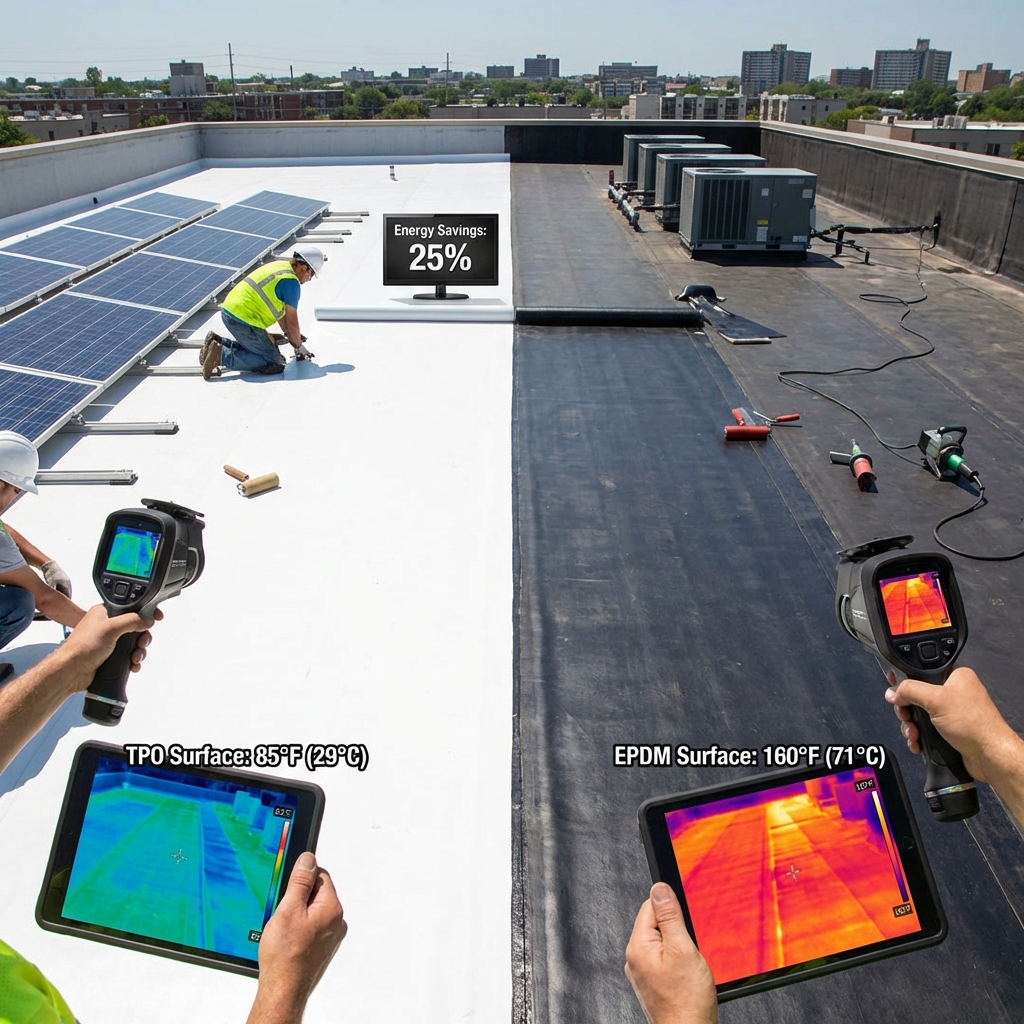
TPO also supports solar panel installations more effectively. The cooler roof surface created by TPO’s reflectivity actually improves solar panel efficiency. If you’re considering future solar investment, TPO is the better base system.
EPDM can be made more efficient with white reflective coatings, but this adds upfront cost and requires maintenance. The coating itself needs reapplication every 5-10 years, introducing labor costs and scheduling complexity.
From a sustainability perspective, TPO has the edge. The manufacturing process for TPO has become more eco-friendly, and TPO membranes are increasingly recyclable at end of life. EPDM is harder to recycle, though some facilities now handle it. If sustainability certifications matter for your business, TPO supports green building credentials more naturally.
Both systems have long lifespans that reduce waste compared to shorter-lived roofing materials. That said, TPO’s reduced energy consumption over 20+ years provides environmental benefit beyond just the roofing material itself.
What to do next: Calculate your annual energy costs and project them over 20 years. TPO’s efficiency advantage typically justifies its choice for climate-controlled buildings.
Maintenance Requirements and Lifespan Expectations
TPO needs surprisingly little maintenance once installed. Annual inspections are wise, checking for punctures, debris accumulation, and fastener corrosion. Beyond that, keeping gutters and drains clear is the main task. We recommend inspections after severe weather. Total annual maintenance cost: $300-600 for a 10,000-square-foot roof.
EPDM requires more active care. Adhesive seams should be inspected regularly for separation or degradation. The membrane itself is generally durable, but seam maintenance becomes increasingly important after year 10. Additionally, if you’ve chosen reflective white EPDM, recoating happens every 7-10 years at $1,500-3,000 for a medium-sized roof. Annual inspections, plus the periodic recoating, push maintenance costs to $800-1,200 yearly (accounting for the recoating cycle).
Regarding lifespan, both systems can reach 20-25 years with proper installation and maintenance. EPDM has documented cases of 30+ year roofs still functioning, but these are well-maintained properties in stable climates. TPO has been in wide use for 25+ years now, and long-term performance data is solidifying. We expect modern TPO to match EPDM’s longevity as the formulations continue improving.
The critical factor for both is installation quality. A poorly installed TPO roof fails sooner than a poorly installed EPDM roof because EPDM’s thickness masks some installation errors. However, a professionally installed TPO roof from a qualified contractor outperforms a mediocre EPDM installation every time.
This is where our 15-year workmanship warranties matter. We back our installation quality, which means proper seam work, correct fastener spacing, and attention to detail that keeps both systems performing for their full lifespan.
What to do next: Commit to annual inspections regardless of which system you choose. That’s the single biggest predictor of maximum lifespan for either TPO or EPDM.
Why Our Local Expertise Matters for Your Choice
Wisconsin weather is specific. Our freeze-thaw cycles are brutal compared to most of the country. Our UV intensity is moderate, but our wind and snow loads are significant. A roofing system that excels in Arizona or Florida might underperform in Brookfield.
We’ve installed both TPO and EPDM on hundreds of commercial properties across our service area. That’s not just experience; it’s knowledge of how each system behaves when exposed to the particular stresses our climate creates. We know which installation techniques matter most in Wisconsin conditions.
Local understanding also means we maintain relationships with material suppliers, know which TPO and EPDM products perform best in our region, and can source quality materials without the supply chain delays that plague some national contractors. When you work with us, you’re not getting generic roofing advice; you’re getting strategies tuned to Brookfield’s specific environment.
We also understand local building codes, which sometimes favor one system over another. Our familiarity with regional inspectors and municipal requirements means your installation passes the first time, avoiding costly delays.
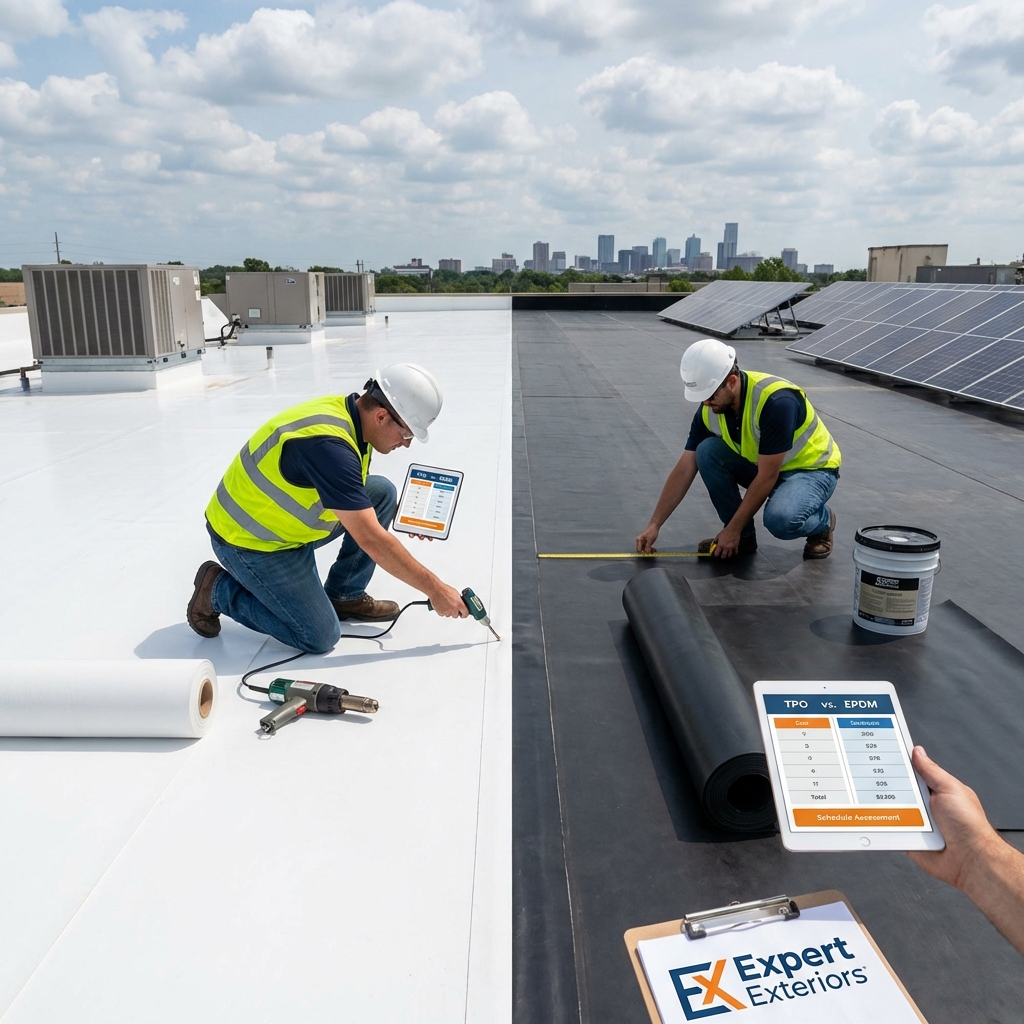
Perhaps most importantly, we’re here for long-term service. If issues arise after installation, we’re a phone call away, not a distant company you reached through a national referral site. For a building system that protects your business, that local accountability matters.
Our Proven Track Record with Both Systems
We don’t push one system over the other because we’re specialists in both. Our projects showcase TPO installations that have performed flawlessly for 12+ years and EPDM systems that continue protecting commercial properties 15+ years post-installation.
That balanced experience is valuable precisely because it means we can recommend the right system for your specific situation, not the system we prefer or that carries better margins. We’ve recommended EPDM to clients whose buildings need maximum cold-weather flexibility, and we’ve recommended TPO to clients chasing energy efficiency and lower maintenance.
One recent project involved a commercial office building with significant summer cooling demands. The owner initially leaned toward EPDM based on a roofing estimate they received elsewhere. We ran an energy analysis and showed them that TPO would deliver $12,000 in energy savings over 10 years. They chose TPO, and their utility records confirmed our projection. That’s the kind of analysis we do routinely.
Another property faced a budget constraint. They were torn between replacing their roof or extending the life of their current system. We recommended EPDM for its proven 25+ year lifespan and reassured them the investment would outlast their ownership timeline. Three years later, they’ve had zero roof issues.
About our team, we bring genuine expertise to these decisions. This isn’t theoretical knowledge from a textbook; it’s accumulated from installing, inspecting, and maintaining both systems in Wisconsin for years.
Making the Right Decision for Your Property
Here’s the framework we use to help clients choose:
Choose TPO if:
- Your building has significant air-conditioning and energy costs matter
- You want lower long-term maintenance and fewer recurring expenses
- Wind exposure is a concern
- Future solar installation is possible
- You prioritize total cost of ownership over initial price
Choose EPDM if:
- Your building is in a hail-prone area or exposed to severe impacts
- Roof access is frequent in winter (maintenance flexibility at cold temperatures)
- You value proven, long-term track record with minimal variables
- Your building doesn’t require heavy cooling
- You prefer thicker, more forgiving material for foot traffic
For most commercial properties in Brookfield, TPO emerges as the stronger choice because it combines energy efficiency, lower maintenance, superior wind resistance, and comparable durability at a lower initial cost. But that’s a general statement, not a universal rule.
The decisive move is getting a professional assessment of your specific building. We account for your roof’s orientation, your building’s cooling demands, local weather exposure, your maintenance capacity, and your financial timeline. Only after understanding those factors does the right choice become clear.
We also secure quotes from our material suppliers and show you the actual installed cost, not generic pricing from national calculators. Your roof’s complexity, access conditions, and any structural work needed all influence final cost.
Schedule Your Free Commercial Roofing Assessment Today
We’re ready to guide you through this decision with a free assessment of your building’s roofing needs. During that conversation, we’ll evaluate your current roof condition, discuss your energy goals and maintenance preferences, and explain how TPO and EPDM perform under the specific conditions your property faces.
You’ll receive a clear recommendation based on your situation, not a generic pitch. We’ll show you projected energy costs, maintenance requirements, and long-term value for both systems so you can make an informed decision.
Contact us at your convenience. We serve Brookfield and surrounding areas with commercial roofing services that include TPO and EPDM installation backed by our 15-year workmanship warranty. When you’re ready to protect your business with a roof system that delivers real performance and lasting value, we’re here to make it happen.