

Best Roofing Material for Wisconsin: Asphalt vs. Metal Comparison
Why Wisconsin Property Owners Face Critical Roofing Decisions
Living and owning property in Wisconsin means dealing with some of the toughest weather conditions in the country. We see homeowners and commercial property owners facing brutal winters with heavy snow loads, ice dams, and freeze-thaw cycles that test roofing materials year after year. Then summer brings intense UV exposure and afternoon thunderstorms. This climate creates a genuine dilemma: choose a roofing material that can actually handle what Wisconsin throws at it, or watch your investment deteriorate faster than you’d expect.
The stakes are real. Your roof isn’t just an aesthetic choice. It’s the primary protection for your home’s structure, insulation, and everything inside. Pick the wrong material, and you’re looking at premature deterioration, costly repairs, and potential interior water damage. We’ve worked with countless property owners who selected their original roofing based on price alone, only to discover they needed replacement or major repairs within 10-15 years instead of 25-30.
The good news is that understanding the two most common options available to you—asphalt shingles and metal roofing—gives you the clarity to make a choice that actually aligns with Wisconsin’s climate demands and your property’s long-term value.
What We Look for in Long-Lasting Roofing Materials
When we evaluate roofing materials for our clients, we focus on several performance criteria that matter specifically in Wisconsin. First, we assess temperature resilience. Wisconsin experiences temperature swings of 80 to 100 degrees Fahrenheit between winter and summer. Your roofing material needs to expand and contract without cracking, splitting, or losing its integrity.
Second, we evaluate wind resistance and weather penetration. Wisconsin isn’t known for hurricanes, but we do experience heavy wind events, and our winter storms can be severe. Materials that can withstand sustained winds and shed water effectively during heavy rain and snowmelt prevent costly water intrusion.
Third, we consider lifespan and maintenance requirements. Some materials demand regular upkeep. Others are relatively self-sufficient once installed properly. For property owners managing multiple responsibilities, lower maintenance is genuinely valuable.
Finally, we look at how a material performs in our specific freeze-thaw environment. This is where many materials fail. When snow melts into gaps or under materials, then refreezes, it creates ice dams and pressure that degrades fasteners, flashing, and the material itself.
Key criteria we always evaluate:
- Temperature range tolerance without warping or brittleness
- Wind resistance ratings (typically 110+ mph for our region)
- Water shedding capability during heavy precipitation
- Fastener durability and resistance to rust
- Performance through repeated freeze-thaw cycles
- Ease of repair if damage occurs
- Expected lifespan under Wisconsin conditions
Asphalt Shingles: Lifespan and Performance in Wisconsin Winters
Asphalt shingles remain the most common residential roofing choice in Wisconsin, and we understand why. They’re affordable upfront, widely available, and relatively simple to install. Most manufacturers rate asphalt shingles for a 20 to 30-year lifespan under ideal conditions.
However, Wisconsin isn’t ideal conditions. We’ve seen asphalt shingles perform reasonably well for 15-20 years in our climate, with noticeable degradation starting around year 12-14. The culprit isn’t just time. It’s the constant thermal cycling. When temperatures fluctuate dramatically, asphalt becomes brittle in winter and soft in summer. The granules that protect the asphalt layer gradually loosen and wash away, especially during spring thaw and summer storms.
Ice dams deserve special attention here. When winter snow melts on a warm roof and refreezes at the cold eaves, water backs up under shingles. Asphalt shingles rely on gravity and nail fasteners to stay secure. Once water penetrates underneath, it can travel backward into your attic and into your walls. We’ve responded to numerous emergency calls from property owners dealing with interior water damage caused by ice dam issues beneath asphalt roofing.
The nails that fasten asphalt shingles face their own challenge. In Wisconsin’s climate, nails can work loose over time due to repeated expansion and contraction. After 10-15 years, we often find shingles that are held primarily by adhesive, with nails partially withdrawn. This leaves them vulnerable to high winds.
Reality check on asphalt shingles in Wisconsin:
- Expect genuine replacement or major repair around year 15-18, not the manufacturer’s 25-30 year estimate
- Routine maintenance becomes necessary around year 10 (sealing, replacing curled shingles, addressing granule loss)
- Ice dam damage is common and often not covered by homeowners insurance
- Wind-related damage increases significantly after year 12
- Summer UV exposure causes ongoing deterioration, especially in southern-facing areas
Metal Roofing: Durability and Weather Resistance Standards
Metal roofing stands fundamentally different from asphalt. We typically install two types: standing seam metal (where vertical seams are raised and interlocked) and metal shingles that mimic traditional aesthetics. Both offer superior performance in Wisconsin’s climate compared to asphalt.
Metal’s primary advantage is material resilience. Steel or aluminum doesn’t become brittle in cold or soft in heat. It maintains its structural integrity through the full range of Wisconsin’s temperature swings without cracking, warping, or losing protective coatings. When winter temperatures drop to 20 below and summer heat climbs into the 90s, metal simply handles the transition.
The thermal movement that causes asphalt to fail actually benefits metal installations. Quality metal roofing systems are designed with expansion and contraction in mind. The fastening system and seams allow for movement without stress or failure. Ice dams still occur with metal roofing, but the material and seam design prevent water penetration. Water sheds immediately rather than backing up under the material.
Wind resistance is where metal really shines in our market. Standing seam systems are rated for 140+ mph wind speeds when properly installed. We’ve seen metal roofs survive Wisconsin’s worst storms without a single nail or fastener failing, while nearby asphalt roofs were completely compromised.
Metal roofing also delivers virtually zero maintenance. There’s no granule loss, no curling, no brittle spots. The protective coating systems we use (Kynar 500 or similar) resist UV damage far better than asphalt, maintaining color and integrity for decades. You don’t need to seal it, replace individual shingles, or perform routine repairs.
Metal roofing performance standards in Wisconsin:
- Lifespan of 40-50+ years with minimal maintenance
- Standing seam wind resistance exceeds 140 mph
- Temperature tolerance: handles the full range from -20F to 95F+ without compromise
- Ice dam resistant: water sheds immediately, no backing up underneath
- UV protection: coating systems rated for 30+ years without significant degradation
- Fastener corrosion resistance: proper fastening systems prevent rust and pullout
- Emergency repair simplicity: damaged panels can be replaced individually without affecting surrounding areas
Cost Comparison: Initial Investment and Long-Term Value
This is where the conversation often stalls for property owners. Metal roofing costs more upfront. A typical asphalt roof replacement runs $8,000 to $15,000 for a residential property in our area, depending on complexity. Metal roofing typically ranges from $15,000 to $25,000 for the same property.
That’s a real difference, and we don’t minimize it. If budget is absolutely constrained, asphalt is the only available option for some homeowners.
But here’s what we ask property owners to consider: lifecycle cost. Let’s use a realistic example. Suppose you install a quality asphalt roof today at age 40 on a property you plan to own for 30 years. Most likely, you’ll need significant repairs or complete replacement around year 15-18. You might get another 10-12 years from patch repairs, then face another full replacement in your late 60s or early 70s. That’s two replacements over your ownership period.
Metal roofing installed today lasts 40-50 years. You’ll very likely never replace it again during your ownership. Beyond material cost, this means one installation cost instead of two, significantly lower maintenance and repair expenses over 30 years, and zero disruption from major roof work during your ownership.
Realistic lifecycle cost comparison over 30 years:
- Asphalt path: Initial $10,000 + Year 15 replacement $12,000 (with inflation) + maintenance/repairs $2,000-3,000 = approximately $24,000-25,000
- Metal path: Initial $18,000 + minimal maintenance $500-1,000 over 30 years = approximately $18,500-19,000
Additionally, metal roofing offers energy benefits. The reflective properties reduce cooling costs in summer, sometimes offsetting the initial premium through energy savings. Some property owners see monthly utility reductions of 10-15% with metal roofing, depending on climate control patterns.
How Wisconsin Weather Impacts Roofing Material Selection
Wisconsin’s climate isn’t generic cold weather. It’s a specific combination of factors that directly determines whether a roofing material will thrive or struggle over time.
Our winters include significant snow load. A typical Wisconsin winter deposits 40-60 inches of snow across the state. While roofing materials themselves handle this weight, the real issue is what happens during the thaw cycle. We get warm days in March and early April that melt surface snow, creating water that runs downslope and refreezes at night. This creates ice dams. Asphalt roofs are particularly vulnerable because water can work its way under shingles and then refreeze, causing damage that isn’t visible until interior water damage appears.
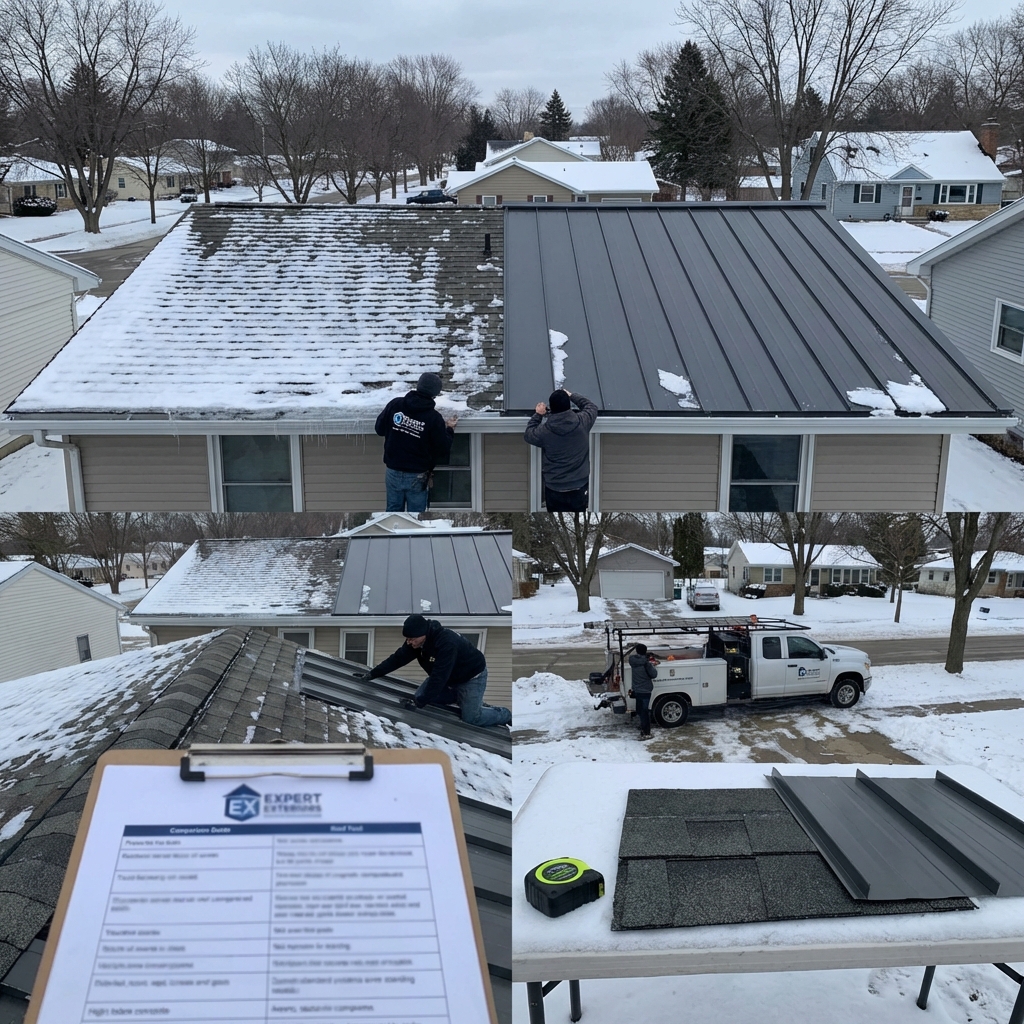
Spring and fall bring intense precipitation events. We receive 3-5 inches of rain in single storm events multiple times per year. Materials that don’t shed water immediately experience backing up, which leads to leaks. The seam design matters enormously here. Asphalt shingles depend on overlap and gravity. Metal roofing systems are engineered to shed water instantly, regardless of slope.
Summer UV exposure in Wisconsin is more intense than many property owners realize. Our clear summer days with low humidity create strong UV conditions. Asphalt’s protective granules gradually oxidize and wash away under this exposure. Metal roofing with quality coating systems is engineered specifically to resist this degradation.
Finally, Wisconsin’s temperature swings are significant. We experience 80-100 degree temperature differences between winter and summer. Some days jump 40 degrees in a single afternoon. This constant thermal cycling is uniquely tough on materials that expand and contract differently than their substrates. Metal’s uniform expansion and engineered seam systems handle this effortlessly. Asphalt gradually develops cracks and separations.
Our Recommendation: Why Expert Exteriors Chooses Metal Roofing
After years of installing roofing across Brookfield and surrounding areas, our recommendation for most Wisconsin property owners is straightforward: metal roofing is the superior choice for residential and commercial properties in this climate.
This isn’t about aesthetics, though metal roofing looks excellent (we have numerous examples in our project gallery). It’s about performance, durability, and genuine value over the time you own the property.
We choose metal roofing for our own buildings and for our clients because it delivers on what Wisconsin demands: material that doesn’t degrade in our temperature swings, seam design that prevents ice dam damage, fastening systems that don’t work loose over time, and protection that lasts 40+ years without maintenance cycles.
When we install roof replacement services with metal materials, we’re confident about the outcome. We stand behind our work with a 15-year workmanship warranty, but we’ve installed metal roofs 20+ years ago that are performing as well as the day we finished. We can’t say the same about asphalt installations we completed in our earlier years.
Metal roofing also aligns with modern property value expectations. More homebuyers and commercial clients now recognize metal’s durability advantage. A home with a newly installed metal roof carries that durability story forward. That matters for resale value and insurance considerations.
Why Asphalt Falls Short in Wisconsin’s Climate
We want to be fair about asphalt’s limitations in our specific environment. Asphalt shingles were developed for climates with gentler temperature ranges and more moderate weather. They’re engineered to shed water and maintain integrity in conditions quite different from Wisconsin’s reality.
The freeze-thaw problem is fundamental to Wisconsin’s geography. When asphalt shingles experience repeated freezing of water underneath them, the material has no mechanism to shed that water from its underside. It simply freezes there. Over years, this causes granule loss to accelerate, fasteners to corrode from the underside, and eventual leaks. We’ve responded to emergency calls where interior water damage became visible only after months or years of hidden deterioration.
Asphalt’s adhesive sealants also struggle in Wisconsin. These adhesives are designed to function between 40F and 85F for optimal performance. Wisconsin regularly experiences temperatures outside this range. Early morning temperature swings can be 50 degrees or more. The adhesive that holds overlapping shingles together cycles between soft and brittle daily. After 10-15 years, these seals fail, allowing wind and water to penetrate.
Maintenance becomes a real cost we see property owners underestimate. Asphalt roofs require periodic inspection, replacing curled or missing shingles, clearing gutters and valleys of accumulated granules, addressing minor leaks, and managing ice dam prevention (which often requires expensive heat cables or professional removal). Over 20 years, this maintenance easily reaches $2,000-3,000, sometimes more. Metal roofing requires almost none of this.
Finally, asphalt’s relatively short functional lifespan in Wisconsin means you’re dealing with major roof work during important life phases. A roof replacement typically costs $10,000-15,000 and involves significant disruption to your home or business. Facing this expense at an unexpected time creates genuine financial stress.
The Expert Exteriors Advantage for Your Roof Replacement
When you choose Expert Exteriors for your roof replacement, you’re working with a team that understands Wisconsin’s climate demands intimately. We’re not applying generic installation methods to your property. We’ve been serving Wisconsin's service area for years, and we’ve learned exactly what works and what creates problems down the road.
Our installation practices exceed manufacturer standards. We use fastening systems rated for 140+ mph wind speeds even when manufacturer specs allow lower ratings. We address ice dam prevention through proper ventilation and flashing design, not hoping the material alone is sufficient. We select coating systems and metal gauges optimized for Wisconsin’s specific environmental stressors.
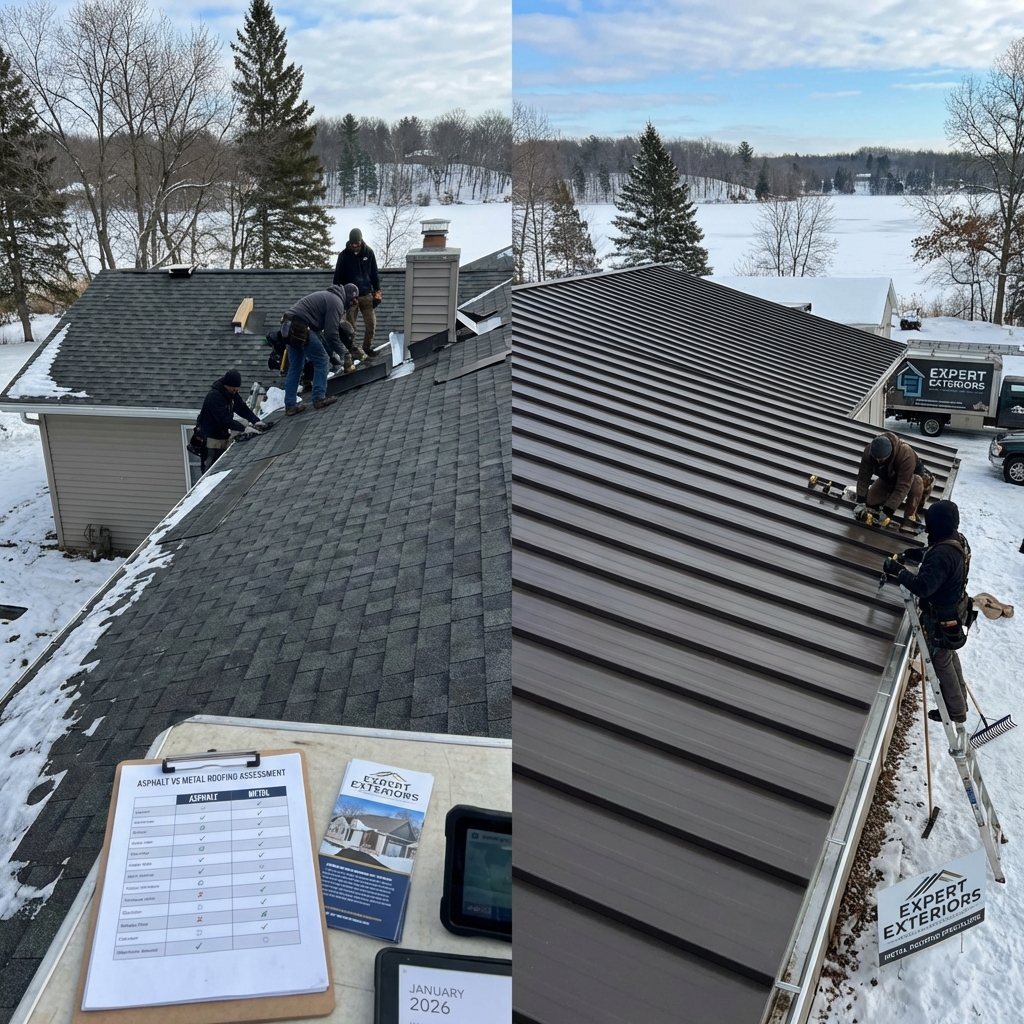
We stand behind our work completely. Our 15-year workmanship warranty reflects confidence in our installation quality. But practically speaking, we’ve never seen a properly installed metal roof fail within that warranty period. The material itself carries manufacturer warranties extending to 30+ years for systems we install.
Our team also understands the installation complexity that many contractors overlook. Proper metal roof installation on Wisconsin homes requires specific attention to ridge design (to prevent ice dam formation), valley construction, flashing around penetrations, and fastener placement that accounts for thermal movement. These details separate a roof that lasts 40 years from one that develops problems at year 8-10.
We also manage the entire project professionally, handling permits, inspections, and coordination with your local utility if needed for chimney or vent work. You’re not juggling multiple contractors or worrying whether all the details are coordinated properly. We handle it completely.
Real Results: Wisconsin Homeowners Who Switched to Metal
The strongest endorsement for metal roofing comes from Wisconsin property owners who’ve experienced both materials. We work regularly with homeowners whose previous asphalt roofs failed or needed major repair, and who switched to metal for their replacement.
One Brookfield homeowner we worked with had experienced ice dam damage twice in 12 years with asphalt roofing. The first incident cost $4,000 in interior water damage repairs. The second incident, four years later, cost even more because the damage affected a second-floor bedroom. After the second incident, she chose metal roofing for replacement. Five years later, she’s had zero water intrusion issues, even during Wisconsin’s harshest winters. She’s never once had to worry about ice dams or emergency roof repair calls.
Another client, a commercial property owner, faced the expense of roof replacement on a 12,000 square foot building every 15-18 years with asphalt. The roof was showing deterioration at year 13. Rather than face another similar cycle, he invested in standing seam metal roofing. That was 16 years ago. The roof looks nearly new today and requires no maintenance beyond gutter cleaning.
A residential contractor we know installed an asphalt roof on his own home. Within 12 years, curling shingles and granule loss forced him to consider early replacement. Instead, he chose metal for the replacement. When we spoke with him recently, he mentioned that the difference in performance and worry-free ownership was so significant that he now recommends metal to every client who can accommodate the upfront cost.
These aren’t isolated experiences. They’re the pattern we see consistently. Property owners who have lived through asphalt roof deterioration in Wisconsin almost universally recognize metal’s advantage when they understand the lifecycle cost.
Getting Your Wisconsin Roof Replacement Right
If you’re considering roof replacement, start with a realistic assessment of your current roof’s condition and your ownership timeline. If you plan to own your property for less than 10 years, asphalt may be cost-justified despite its climate limitations. If you plan to stay longer, metal becomes the economically superior choice.
Next, get a professional roof inspection. Don’t rely on distant observation or contractor estimates. A detailed inspection identifies whether your roof has years of life remaining or whether replacement is imminent. We perform comprehensive assessments that give you complete clarity about your actual situation.
When you’re ready to move forward with replacement, prioritize working with contractors experienced in Wisconsin climate conditions. A contractor accustomed to mild-climate roofing may miss critical details that prevent ice dam issues, wind damage, or thermal movement problems. Experience with Wisconsin’s specific challenges matters significantly.
Also, ask prospective contractors about their warranty coverage and their process for addressing warranty claims. Our 15-year workmanship warranty isn’t just fine print. It’s our commitment to standing behind the work completely. Contractors confident in their installation quality offer substantial warranties. Those offering minimal coverage are acknowledging their own uncertainty about performance.
Finally, consider the complete value equation, not just the upfront cost. A roof is a 30+ year investment (or should be). Spreading the total cost of ownership over that timeframe often reveals that metal’s higher upfront cost actually delivers better value than asphalt’s lower initial expense paired with maintenance, repairs, and premature replacement costs.
Schedule Your Roofing Assessment with Expert Exteriors Today
You deserve a roof that protects your property reliably for decades without continuous worry or unexpected repair costs. Metal roofing delivers that in Wisconsin’s climate in ways asphalt simply cannot match.
If you’re evaluating your roofing options or noticing signs that replacement is approaching, let’s have a straightforward conversation about what makes sense for your specific property and situation. We’ll assess your current roof condition, discuss how metal roofing performs in Wisconsin’s environment, and explain what we can deliver for your home or commercial building.
Schedule your assessment today through our instant roof quote system, or contact our team directly to discuss your roofing project. We’re ready to help you make the decision that protects your investment for the next 40 years.