
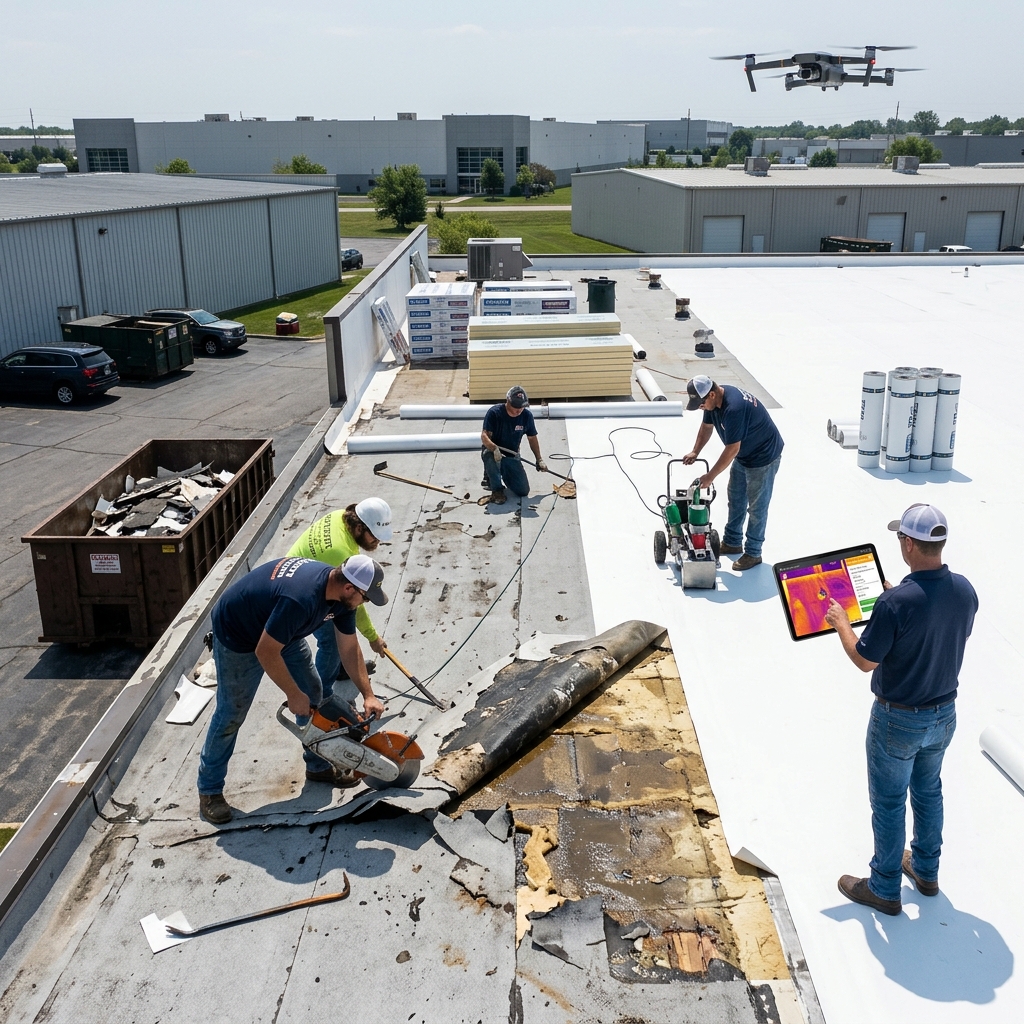
Commercial TPO Roofing Replacement: Complete Cost Guide and ROI Analysis
Why Commercial TPO Roofing Fails and What It Costs Your Business
A leaking roof doesn’t announce itself with fanfare. It starts small: a stain on the ceiling, a soft spot in the membrane, water pooling in corners after heavy rain. By the time most business owners notice, the damage has already begun eating into their bottom line.
Commercial TPO roofing typically lasts 15-20 years with proper maintenance, but premature failure happens more often than most property owners realize. UV exposure, poor installation, inadequate drainage, and weathering all contribute to membrane degradation, seam separation, and punctures. When these issues develop, the costs cascade quickly.
A single water intrusion incident can cost $5,000 to $15,000 in water damage repair, mold remediation, and business interruption. Repeated leaks compound the problem. That’s before considering the energy loss from compromised insulation, the liability exposure of a failing roof, and the operational headaches of emergency repairs.
The real question isn’t whether you’ll eventually replace your TPO roof, but whether you’ll do it proactively on your timeline or reactively under crisis conditions. The difference in cost and disruption is substantial. We’ve seen emergency roof replacements run 30-40% higher than planned projects simply because contractors lack scheduling flexibility and material availability becomes constrained.
Understanding TPO Roofing and Why We Choose It for Commercial Properties
TPO (thermoplastic polyolefin) has become the go-to material for commercial flat and low-slope roofing over the past 15 years, and for good reasons. It’s a single-ply membrane that combines flexibility, durability, and energy efficiency in ways that older built-up roofing systems simply don’t match.
TPO offers several core advantages we consistently observe on our commercial projects:
- Energy efficiency: White TPO membrane reflects UV rays, reducing cooling costs by 10-20% compared to dark roofing materials
- Seam strength: Heat-welded seams create a monolithic surface with minimal leak points when installed properly
- Chemical resistance: TPO resists oil, grease, and common rooftop contaminants better than alternatives
- Installation speed: TPO installation typically moves faster than built-up or EPDM systems, reducing labor time and project timeline
- Longevity: Quality TPO with proper maintenance delivers 20+ years of service life
We specify TPO for commercial roofing solutions because it balances performance with value. It’s more affordable than some premium options yet more durable than older alternatives. For businesses focused on long-term protection and operating efficiency, TPO consistently delivers the best return on investment.
However, TPO isn’t a one-size-fits-all solution. The material itself must be installed correctly, the substrate must be properly prepared, and ongoing maintenance must happen on schedule. Failures we encounter typically stem from installation shortcuts, inadequate drainage design, or deferred maintenance rather than material deficiency.
Breaking Down Commercial TPO Roof Replacement Costs
Commercial TPO roof replacement cost varies widely based on multiple factors, but understanding the component costs helps you evaluate quotes and plan budgets accurately.
Material costs typically represent 40-50% of the total project price. Quality TPO membrane runs $0.75 to $1.25 per square foot depending on thickness (typically 60-80 mil). For a 10,000 square foot roof, expect $7,500 to $12,500 in material costs alone. This includes the membrane, adhesives or fasteners, and termination details.
Labor constitutes 35-45% of total cost. Commercial roofing is specialized work requiring certified installers, safety protocols, and equipment. Expect $1.00 to $2.00 per square foot in labor on a straightforward TPO installation. Complexity increases labor costs significantly, which we address below.
Additional components round out the budget:
- Substrate repair and preparation: $500-$3,000+ depending on existing conditions
- Insulation replacement: $0.50-$1.50 per square foot if required
- Flashing and edge details: $500-$2,500
- Removal and disposal of old roofing: $0.25-$0.75 per square foot
- Permits and inspections: $200-$1,000 depending on your municipality
A typical 15,000 square foot commercial TPO replacement in the Brookfield area runs between $25,000 and $50,000. Smaller commercial buildings often cost proportionally more per square foot due to fixed costs. Larger facilities achieve better per-square-foot pricing.
Getting an instant roof quote from our team helps you understand where your specific project lands within this range. Every building is different, and we’ve learned that ballpark estimates without site details lead to budget surprises.
How Square Footage and Complexity Affect Your Project Price
Project price scales with square footage, but not linearly. A 5,000 square foot roof doesn’t cost exactly one-third of a 15,000 square foot roof. Understanding why protects you from overpriced quotes and helps you allocate budget appropriately.
Square footage sets the base line for material and labor. Doubling the roof area roughly doubles those core costs. But fixed costs like permits, equipment mobilization, and project management don’t double. For this reason, larger projects typically offer better per-square-foot pricing.
Complexity, however, introduces the biggest cost variables. We’ve completed two 8,000 square foot commercial TPO replacements where one cost $18,000 and another cost $28,000. The difference wasn’t the roofing material; it was the building layout.
Several complexity factors significantly impact your final cost:
Roof access and safety infrastructure: A single-story office building with a simple sloped roof takes hours to complete. A multi-level structure with mechanical equipment, HVAC units, and rooftop piping requires extra safety rigging, equipment protection, and careful coordination. This alone can add $3,000-$8,000 to labor costs.
Number of penetrations and details: Every skylight, vent stack, HVAC unit, or equipment island requires custom flashing. One building might have 6 penetrations; another nearby might have 40. Each adds both material and labor time. Expect $200-$500 per major penetration in added cost.
Substrate condition and structural issues: When we remove old roofing, we sometimes discover deck damage, wet insulation, or structural concerns requiring remediation. If your existing roof hides rot, deterioration, or structural problems, substrate repairs can quickly exceed $10,000.
Slope and drainage design: Flat roofs should slope toward drains to prevent water ponding. If the existing structure doesn’t accommodate proper drainage, we may need to add additional slope using tapered insulation or a new sloped substrate. This increases both material and labor significantly.
Building occupancy and season: Replacing a roof over an occupied building requires coordination, noise restrictions, and extended work schedules. Seasonal timing matters too; winter or rainy season replacements take longer than summer work, adding labor costs.
Before getting quotes, document your roof’s square footage and sketch out the penetrations and complexity factors. This information helps contractors provide accurate estimates and prevents sticker shock.
Energy Savings and Long-Term Value of TPO Roofing
The initial cost of a TPO roof replacement represents just the first layer of your investment. The real value emerges over 15-20 years through energy savings, extended equipment life, and improved facility protection.
A white TPO membrane reflects 70-80% of solar radiation compared to dark roofing materials that absorb 90% or more. For commercial buildings with significant cooling loads, this translates to measurable utility savings. In the Brookfield climate, we typically see energy cost reductions of 10-20% on buildings that switch from older dark roofing to white TPO.
Consider a 20,000 square foot commercial building with annual cooling costs of $12,000. A 15% reduction saves $1,800 annually. Over a 20-year roof life, that’s $36,000 in cumulative energy savings. For many businesses, this single benefit approaches or exceeds the total roof replacement cost.
Energy savings vary based on several factors:
- Existing roof color and reflectivity: Dark roofs show larger energy reductions when replaced with white TPO
- HVAC system efficiency: Newer, more efficient systems capture bigger savings
- Climate and building orientation: Buildings with south and west-facing exposure benefit most
- Building insulation: Better-insulated buildings show more dramatic cooling cost reductions
- Occupancy and operational patterns: Buildings with consistent daytime occupation show different savings than those with variable usage
Beyond energy, TPO roofing protects your building envelope more effectively than deteriorating older roofs. Preventing water intrusion avoids:
- HVAC system damage and premature replacement (often $8,000-$15,000)
- Structural wood rot and ceiling replacement (highly variable but potentially $20,000+)
- Mold remediation and indoor air quality problems (can exceed roof replacement cost)
- Business interruption and productivity loss during emergency repairs
We view TPO roofing as protective infrastructure that preserves your broader building investment rather than simply as a roof. This perspective changes how you evaluate commercial roof replacement as a business expense.
Timeline and Minimizing Business Disruption During Replacement
Most commercial TPO roof replacements take 3-7 business days depending on square footage, weather, and complexity. However, planning the replacement strategically can substantially reduce operational disruption.
A straightforward 10,000-15,000 square foot roof typically completes in 4-5 days with a full crew. Larger buildings may take 7-10 days split across two weeks. Weather always affects timeline; any rain halts work and adds days to the schedule.

The key to minimizing disruption involves coordinating installation timing with your operational calendar:
Off-season timing: If your business has slower periods, schedule roofing then. A retail business might schedule in late January; a school might schedule over summer break. Shifting the project even two weeks to avoid peak operational periods reduces impact significantly.
Partial mobilization during off-hours: On occupied buildings, some preparatory work (removal of old roofing) can happen during evenings or weekends, with actual TPO installation during normal business hours when crews are present.
Staging and material coordination: We stage all materials on-site before starting, so deliveries don’t disrupt your operations during the actual installation.
Access planning: Coordinating roof access with building management ensures parking lot routing, delivery zones, and daily operations flow smoothly around our crews.
Communication protocols: We assign a project manager who provides daily updates on progress and any operational impacts. Surprises cause more disruption than expected challenges.
Most of our commercial clients report that the actual operational impact is far less than they anticipated. The disruption window is typically 3-5 days of noise and temporary parking limitations, not the weeks of chaos many property owners fear.
Why Our Expert Exteriors Team Delivers Superior Value
We’ve been installing commercial roofing systems across Brookfield and surrounding areas for years, and that experience informs every project we undertake. It’s the difference between a crew that installs roofs and a team that solves roofing problems.
Our approach centers on three commitments:
Proper substrate preparation: We don’t cut corners by installing TPO over damaged or inadequate substrate. Every project begins with thorough assessment and necessary preparation. This upfront rigor prevents the emergency repairs that cost far more down the road.
Installation excellence: Our crews use heat-welded seams and follow manufacturer specifications precisely. Quality seams are the difference between a roof that leaks after 10 years and one that performs for 20. This isn’t negotiable on our projects.
Long-term partnership: We back our work with 15-year workmanship warranties on flat and low-slope roofing installations. More importantly, we maintain relationships with clients through maintenance recommendations and follow-up inspections. We want your roof to succeed over its full lifespan.
Several specific details differentiate our work:
- We use only premium TPO membrane from established manufacturers with proven track records
- Every installer completes manufacturer certification and ongoing training
- We coordinate all permits and inspections, removing that burden from you
- Project managers maintain transparent communication and detailed documentation
- We include a detailed maintenance plan to extend roof life beyond standard expectations
Learning about our team helps you understand the depth of expertise behind your project. This isn’t our first commercial roof, and it won’t be our last.
Financing Options and ROI for Commercial Roofing Investments
A $35,000-$50,000 roof replacement represents a significant capital expense, and many business owners defer the project because of the upfront cost. However, several financing approaches make commercial roofing investment more manageable.
Many property owners overlook financing options available specifically for commercial property improvements. Equipment financing and commercial property improvement loans often carry better terms than business lines of credit. Interest rates typically range from 4-8% for well-qualified borrowers, with terms from 3-10 years.
Before financing conversations, understand your ROI timeline. With energy savings and extended building system protection, most commercial TPO roofs pay for themselves within 8-12 years. This means financing across a 7-10 year term leaves you with 5-15 years of pure cash flow benefit from the roof you’ve already paid for.
The ROI analysis looks like this for a typical replacement:

- Initial investment: $40,000
- Annual energy savings: $2,000
- Avoided emergency repair costs over 20 years: $15,000-$25,000 (estimated based on typical water damage events)
- Extended HVAC and building system life: $10,000-$20,000 (estimated value)
- Total benefit value: $37,000-$67,000
- Financing cost at 6% over 10 years: approximately $4,400 in interest
For many businesses, the total benefit substantially exceeds the investment, even accounting for financing costs. The project often pays for itself through energy savings and avoided maintenance before the loan term ends.
We also work with commercial clients on phased roof replacements. If cash flow is constrained, replacing the worst sections first, then completing additional sections over subsequent years, spreads the cost while addressing critical protection needs immediately.
Common Mistakes That Drive Up Roofing Replacement Costs
After thousands of commercial roofing projects, we’ve identified patterns in what causes costs to exceed initial budgets. Most are avoidable with proper planning.
Deferring the project too long: Waiting until emergency repair is the only option limits contractor availability and increases urgency pricing. We’ve seen this add 20-30% to project costs. Replacing a roof on your timeline costs substantially less than replacing it on the roof’s schedule.
Choosing contractors based primarily on price: The lowest quote often reflects corners cut somewhere: lower-quality materials, inexperienced labor, or incomplete scope definition. We’ve seen businesses replace “budget” installations within 5 years. The total cost of two replacements exceeds a single quality installation.
Underestimating substrate damage: Saying “just replace the roof” without assessing the substrate beneath is false economy. Discovering rotted decking or wet insulation mid-project requires stopping work and renegotiating scope. Building this assessment into initial planning prevents surprises.
Misunderstanding insurance coverage: Many property owners assume insurance covers roofing failures, only to discover that normal wear and tear isn’t covered. Understanding your policy before the roof fails allows better planning and potentially better coverage choices.
Ignoring drainage design: A TPO roof installed over inadequate drainage will fail prematurely. Proper slope and drain positioning cost more upfront but prevent expensive water damage and premature replacement. This is structural investment, not optional upgrade.
Skipping maintenance plans: After installation, many businesses forget about their roofs until problems appear. Regular inspections and maintenance significantly extend life and catch small issues before they become expensive. Budget $500-$1,500 annually for professional roof inspections and maintenance to maximize your investment.
Mixing contractors and materials: Using your general contractor’s roofing “contacts” instead of specialists often introduces coordination problems and quality variability. Roofing is specialized work that benefits from dedicated expertise.
Getting Your Commercial TPO Roof Project Started Today
If your building is showing signs of roof deterioration, or if your existing roof is approaching the end of its serviceable life, starting the replacement process now sets you up for success rather than scrambling later.
The first step is a professional roof assessment. We evaluate your existing roof’s condition, identify any substrate issues, and document the square footage and complexity factors that affect cost. This assessment typically costs $300-$500 but prevents expensive surprises later.
Once assessment is complete, we provide a detailed proposal that covers all aspects of the project: materials, labor, substrate work, permits, timeline, and warranty. No surprises, no hidden costs.
From there, the path forward depends on your timeline and priorities:
- Urgent replacement: If your roof is leaking or showing active deterioration, we can often schedule work within 2-4 weeks
- Planned replacement: If you’re preparing for spring or fall work, we coordinate scheduling to fit your operational calendar
- Budget planning: If you need time to secure financing or plan budgets, we help you lock in pricing and schedule for future installation
Next steps to move forward:
- Request an instant roof quote with your building’s square footage and any known roof issues
- Schedule a site assessment so we can provide detailed recommendations and accurate pricing
- Review financing options and timeline preferences with your team
- Contact us with your preferred installation window, and we’ll coordinate the project from there
Your commercial property is too valuable to leave unprotected by a failing roof. A properly installed TPO roofing system protects your investment, reduces operating costs, and provides peace of mind for years. Let’s get your project scheduled and protect your building the right way.