
Minimizing Tenant Disruption During Multi-Family Roof Replacement Projects
The Challenge of Roofing Multi-Family Properties Without Losing Tenants
Multi-family roof replacements are complex undertakings that require careful planning beyond just the roofing work itself. Property owners and managers face a unique challenge: executing a necessary major renovation while keeping current tenants satisfied, safe, and undisturbed. We understand this balance because we’ve completed dozens of apartment and commercial building roof replacements across Brookfield and surrounding areas. This article walks you through how we approach these projects strategically to protect both your property and tenant relationships.
Managing a multi-family roof replacement feels like conducting an orchestra where every resident is a musician with different schedules, noise tolerances, and expectations. Tenant turnover during renovation projects can damage your property’s value and rental income, while existing tenants who experience poor project management may break leases early or leave negative online reviews that hurt future leasing efforts.
The stakes are genuinely higher with multi-family properties than single-family homes. You’re not just managing one household’s inconvenience; you’re balancing the needs of dozens of families or commercial tenants, each with legitimate concerns about dust infiltration, noise levels, access restrictions, and construction timelines. A poorly executed project can cost you more in lost rent and legal compliance issues than the roof replacement itself.
What makes this manageable is strategic planning that treats tenant communication and workflow coordination as seriously as the actual roofing work. We’ve found that properties that invest time upfront in planning see measurably better tenant retention and satisfaction scores during and after projects.
Why Traditional Roofing Projects Create Tenant Complaints and Lease Violations
Standard roofing approaches often prioritize speed and cost efficiency without accounting for the human disruption involved. When crews work without tenant-specific planning, several predictable problems emerge.
Noise and vibration issues top the complaint list. Tearing off old roofing generates constant hammering, sawing, and heavy equipment movement from early morning onward. Residents working from home, caring for infants, or working night shifts bear the brunt of this disruption. Without noise mitigation planning, you can expect formal complaints within days and potential lease violation claims.
Dust and debris infiltration is a serious concern that property managers rarely anticipate adequately. Roofing work creates fine particles that settle on surfaces, enter through ventilation systems, and accumulate on balconies and patios. Tenants may claim this damages personal property or triggers respiratory issues, leading to liability discussions you’d rather avoid.
Unexpected access restrictions frustrate tenants when crews need to block stairwells, elevators, or parking areas without sufficient advance notice. When a parent can’t access their unit because crews are using the main hallway to move materials, or a tenant returns home to find their parking spot blocked without warning, resentment builds quickly.
Extended timelines and weather delays compound these issues. Projects that extend longer than communicated leave tenants frustrated and questioning whether the property owner is managing the work responsibly. Each delay resets the disruption clock and tests tenant patience further.
These aren’t minor inconveniences. Lease violations, tenant lawsuits, and bad reviews are real financial and reputational risks. Proper project planning prevents these outcomes by building tenant experience into every phase.
How We Plan Multi-Family Roof Projects Around Tenant Schedules
Our planning process begins weeks before our crew arrives on-site. We work directly with property managers to understand the property’s specific needs and constraints, then build a detailed timeline that accounts for tenant patterns.
We start by mapping peak occupancy patterns and identifying tenant demographics when possible. Are there families with young children who need quiet mornings? Are there shift workers who sleep during the day? Do commercial tenants have critical business hours we must protect? This intelligence shapes every scheduling decision we make.
Next, we coordinate with property management to identify any lease language around construction disruption, quiet hours, or access restrictions. Some properties have specific provisions limiting work hours or requiring advance notice periods. We build these requirements directly into our timeline rather than treating them as afterthoughts.
We also assess the property’s layout to identify the least-disruptive material staging and crew access routes. For instance, if the building has a loading dock away from occupied units, we’ll stage materials there rather than the main entrance. If certain stairwells serve fewer units, we use those as primary work routes.
Actionable next step: Before committing to any roof replacement timeline, ask your roofing contractor to present a detailed access map showing material staging, crew parking, and primary work routes. This single document reveals whether they’ve actually planned around your tenants or are planning to wing it.
Our Phased Approach to Minimize Noise and Access Disruption
Rather than tearing off and replacing the entire roof in one continuous work period, we break projects into logical phases that isolate disruption to specific building sections.
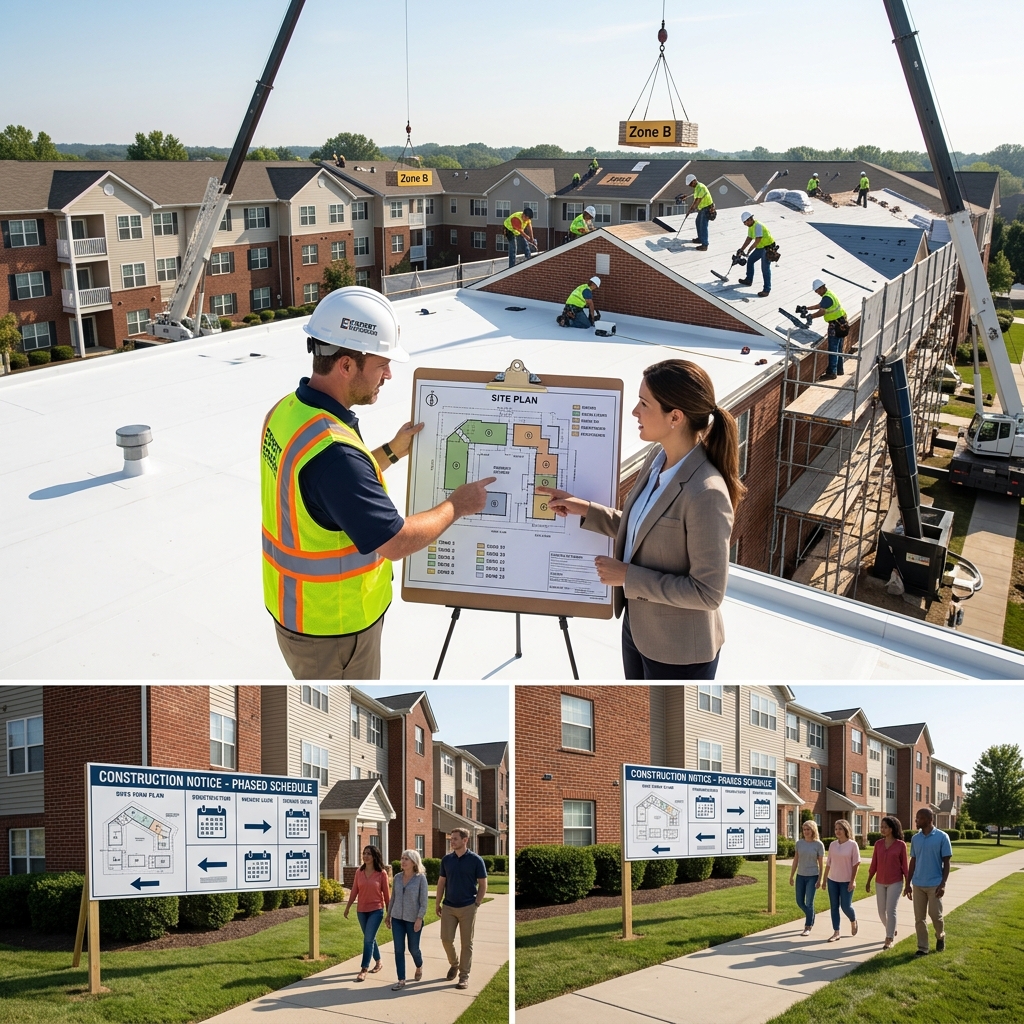
For a typical apartment building, we might divide the roof into quadrants. We complete one section fully (removal, underlayment, new material installation) before moving crews to the next. This approach keeps disruption concentrated geographically, allows temporary weatherproofing between phases, and gives tenants in completed sections relief from ongoing work.
With multi-phase work, tenants know precisely which days their building section will experience peak activity. This predictability actually reduces frustration compared to constant random disruption. They can plan around it, schedule important tasks on quiet days, and feel some control over the situation.
We schedule intensive work (material removal and installation) during mid-day hours when many tenants are away at work or engaged in other activities. Early morning and evening work is limited to essential activities like inspection, cleanup, or material staging. Weekend work is minimized and communicated well in advance.
The phased approach also provides natural checkpoints for quality inspection and adjustment. If weather impacts our schedule, we can shuffle phases without derailing the entire project. If unexpected structural issues appear in one section, we can address them without holding up work on other sections.
Communication Strategy That Keeps Tenants Informed and Cooperative
Even the most perfectly executed phased approach fails if tenants feel left in the dark. Our communication strategy treats transparency as a core project component, not an afterthought.
We begin communication 4-6 weeks before crews arrive. Property managers distribute our initial notification letter explaining the project scope, timeline, and specific information about work hours, access restrictions, and contact procedures. We include a timeline graphic showing exactly when each building section will be under active work.
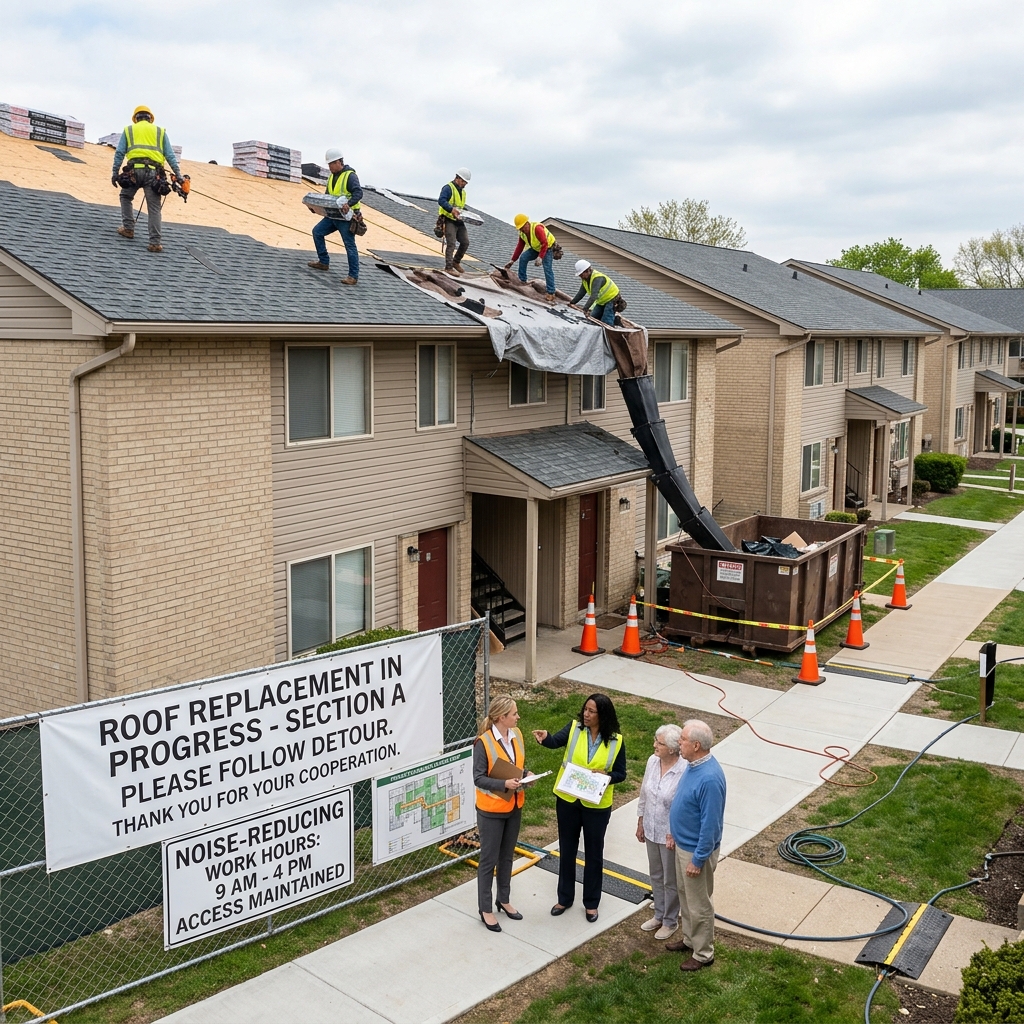
One week before work begins, we post large, clear signage in common areas with specific dates, work hours, and a dedicated project hotline number where tenants can call with concerns or questions. The hotline is monitored daily during work hours and during the evening to catch end-of-day concerns before they escalate overnight.
We provide weekly email updates during the project summarizing what was completed, what’s scheduled for the coming week, and any adjustments to the timeline. These updates go directly to property management for distribution and posting, keeping communication consistent and reliable.
For significant changes (weather delays, timeline adjustments, scope changes), we notify tenants within 24 hours rather than leaving them to discover problems firsthand. A simple call or email from the project manager explaining that rain pushed us back one day prevents the frustration of expecting work that doesn’t happen.
Actionable next step: Ask your contractor to commit to a specific communication schedule in writing. How frequently will they update tenants? Who is the primary contact? What communication channels will they use? A contractor hesitant to define this upfront probably isn’t prioritizing tenant experience.
Advanced Equipment and Techniques We Use for Faster Completion
Timeline is a major tenant disruption factor, so we invest in equipment and techniques that accelerate completion while maintaining quality.
We use air-powered nailers and pneumatic tools rather than loud manual hammering wherever code permits. Pneumatic equipment operates at significantly lower decibel levels than traditional roofing hammers, reducing the constant noise that drives tenant complaints. We also use noise barriers and sound-dampening equipment positioned between work areas and occupied units.
Our crews use mechanical roof removal systems that accelerate the tear-off phase substantially. Instead of traditional manual labor that stretches tear-off over many days, these systems handle removal far more quickly, concentrating the worst disruption into a shorter window. We still clean up meticulously, but the acute noise phase ends faster.
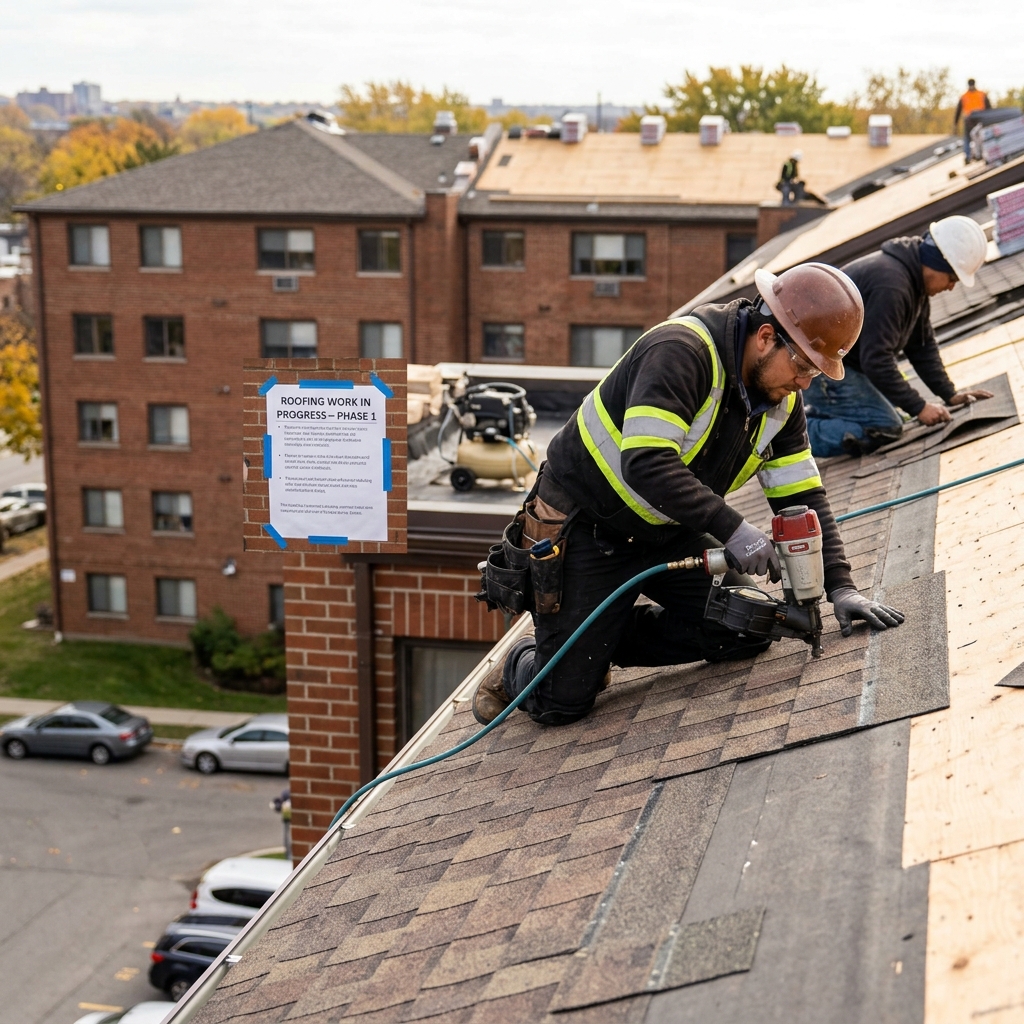
We employ larger crews on multi-family projects than single-family jobs when the property size warrants it. More workers completing the same job in fewer days means tenants experience disruption for a shorter overall period. This requires careful coordination and staging, but the tenant benefit justifies the logistics complexity.
Material delivery coordination prevents the constant truck traffic that disrupts traffic flow and tenant access. We schedule material deliveries in consolidated batches rather than multiple small deliveries spread across weeks. A few intensive delivery days beats daily disruption.
Weather contingency planning is essential for timeline certainty. We pre-stage backup materials, identify covered work that can continue during light rain, and maintain flexible scheduling to capitalize on weather windows quickly. Tenants appreciate a contractor who actually moves efficiently rather than one who stops work at the first cloud.
How Our Crew Protects Tenant Units During Replacement Work
Physical protection of occupied spaces requires discipline and systematic procedures that we build into every project.
We seal all roof penetrations (ventilation, plumbing, mechanical openings) during the tear-off phase with temporary covers. This prevents debris from falling into units below and keeps occupants from experiencing water infiltration or damage during the project. These covers remain in place until final roofing and permanent sealing occur.
Protective barriers are installed at building edges where crews work. Safety netting and tarping prevent debris from falling to ground level where tenants park or walk. This also limits the visible mess from occupied units looking up at the work, which is a small but real contributor to tenant perception of project control.
Our crews wear booties and floor protection equipment when accessing occupied hallways or common areas. Material staging on balconies or in hallways is protected with plywood sheeting to prevent damage to surfaces. We identify any existing roof or unit damage with photos before work begins, so disputes about responsibility for damage are eliminated upfront.
We coordinate with property management to temporarily disconnect HVAC intake vents during tear-off if needed, preventing dust from entering the ventilation system. For properties with through-wall mechanical systems, we provide additional protection to prevent debris accumulation.
Dumpsters are located strategically to prevent tenant access issues and are covered to contain debris. We remove filled dumpsters promptly rather than allowing them to overflow or accumulate waste visibly throughout the project.
Quality Materials That Ensure Long-Term Peace of Mind
While tenant disruption is the focus of this article, the roofing materials we install fundamentally determine whether the project was actually worth the disruption tenants endured.
We specify premium materials appropriate for multi-family buildings and the climate conditions of our Wisconsin service area. For residential apartments, we typically use architectural asphalt shingles or dimensional shingles with high impact and wind resistance ratings. For commercial roofing for multi-unit properties, we work with TPO or EPDM systems installed with premium underlayment for superior weather performance.
Material selection considers not just durability but also tenant experience. Darker architectural shingles provide better thermal performance in winter but can trap heat in summer, so we discuss climate impact with property managers. TPO systems are excellent for commercial multi-family buildings where flat roofing predominates, offering superior UV resistance and reflectivity.
All our roof replacement services include 15-year workmanship warranties on full replacements. For multi-family properties, this warranty protects the property owner’s investment and provides concrete documentation of quality that resonates when discussing the project value with tenants.
We document material specifications, installation photos, and warranty details clearly for property management records. When a tenant asks about the new roof five years from now, property management has confidence in what was installed and the protection it provides.
Post-Project Cleanup and Restoration Procedures We Follow
The final perception of any construction project is heavily shaped by cleanup quality. We treat post-project restoration as seriously as the installation work itself.
Our crews perform daily cleanup during the project, not waiting until final day. Debris is removed from walkways, parking areas, and entry points each afternoon. Dumpsters are checked regularly and emptied before they overflow. This daily discipline prevents the feeling that construction debris is gradually taking over the property.
Final project cleanup involves pressure washing of common areas and walkways to remove dust and debris residue from the work. We remove all temporary signage, barriers, and protective coverings. Parking areas and access routes are swept and cleaned to their original condition.
We provide property management with a detailed final walkthrough checklist identifying any touch-up work, minor repairs, or final items requiring completion. Nothing is considered “finished” until property management explicitly approves the final condition.
Documentation of completion includes before and after photos, a summary of materials installed, warranty documentation, and maintenance recommendations. Property managers receive a complete project binder they can reference years later when tenants ask questions or when planning future maintenance.
Actionable next step: Include cleanup standards in your roofing contract. Specify that daily cleanup is required, that final cleanup includes pressure washing of common areas, and that the project isn’t considered complete until you’ve approved the final condition. Don’t accept “we’ll clean up when we’re done” as sufficient commitment.
Why Property Managers Choose Expert Exteriors for Multi-Family Roofing
Property managers working with us repeatedly come back because we’ve earned their trust by delivering on the specific promises that matter most to them: controlled disruption, consistent communication, and quality results that justify the project.
Our experience across multi-family project galleries demonstrates our capability with complex properties. We’ve completed projects ranging from small apartment buildings to large commercial multi-unit complexes, and each project is documented with photos and tenant feedback.
We maintain strong relationships with property management companies throughout our service area, and our reputation is built on delivering the disruption-minimized experience described throughout this article. When property managers recommend us to peers, they consistently emphasize our tenant communication and project organization.
We also understand the financial relationship with tenants. We know that construction disruption can trigger lease violations, early move-outs, or poor online reviews that damage future leasing potential. Our approach protects the property owner’s rental income stream by keeping current tenants satisfied throughout the project.
Our team includes project managers with specific multi-family experience. They’re not general contractors managing any type of project; they specialize in residential and commercial multi-unit properties and understand the unique dynamics these properties present.
Getting Started With a Disruption-Free Roof Replacement Timeline
If you own or manage a multi-family property where roof replacement is on your horizon, the planning process should begin well before you need the work urgently.
Start by reaching out to schedule a detailed consultation where we assess your property, discuss your specific tenant situation, and develop a preliminary timeline and approach. This consultation is free and gives you concrete information to evaluate whether roof replacement makes sense within your planning timeline.
During the consultation, we’ll ask detailed questions about your tenant base, any specific concerns they’ve raised about current roofing condition, lease language around construction, and your timeline preferences. The more you can share about your property’s specific situation, the more realistic our planning becomes.
We’ll provide a detailed proposal that includes the timeline, phased approach, material specifications, warranty information, and our communication plan. This gives you everything you need to evaluate the project impact on your property and make an informed decision.
Get an instant roof quote online, or contact us directly to discuss your multi-family roofing needs. We’re here to make this process as straightforward and tenant-friendly as possible.