

Commercial Roofing Solutions: EPDM vs. TPO Systems for Your Business
Why Your Commercial Roof Matters to Your Bottom Line
Your roof is performing a critical job: it’s the only thing standing between your building, its contents, and the weather. When it fails, the consequences ripple through your entire operation. Water intrusion leads to structural damage, equipment failures, mold remediation costs, and potential business interruption. We’ve seen commercial property owners face repair bills exceeding $50,000 because a small leak went unaddressed for months.
Beyond emergency repairs, your roofing choice affects your operational expenses year-round. The right system reduces energy costs, minimizes maintenance overhead, and protects your property value. A poorly selected or improperly installed roof becomes a constant financial drain. The decisions you make now determine whether you’re managing a stable, protective asset or inheriting years of headaches.
We approach every commercial roof replacement as an investment decision, not just a construction project. The systems we install are designed to deliver decades of reliable protection while optimizing your long-term costs. Your choice between EPDM and TPO isn’t trivial; it shapes your building’s performance and your maintenance budget for the next 20+ years.
Understanding EPDM Roofing: What We Install for Long-Term Protection
EPDM (Ethylene Propylene Diene Monomer) is a synthetic rubber membrane that has been the workhorse of commercial roofing since the 1960s. We select EPDM for projects where proven durability and UV resistance matter most. The material stands up exceptionally well to ozone exposure, UV radiation, and temperature extremes, which is why it remains the most popular flat roofing material in North America.
The way EPDM works is straightforward: we install large sheets of rubber membrane across your roof deck, securing them either mechanically or with adhesive depending on your building’s structure. The seams are sealed with specialized tape or liquid adhesives. What we appreciate about EPDM is its flexibility; the rubber can expand and contract with temperature changes without cracking, making it forgiving of building movement and settling.
From a practical standpoint, EPDM offers several tangible benefits:
- Longevity: Most EPDM systems we install last 25-30 years with proper maintenance, and many exceed that timeline
- Cost-effective: EPDM typically costs less upfront than TPO or other premium systems
- Repair simplicity: If damage occurs, patches are straightforward and don’t require specialized equipment
- Cold weather performance: EPDM remains pliable in freezing conditions, reducing cracking risk
One consideration: EPDM appears dark (usually black), which can absorb heat and slightly raise cooling costs compared to light-colored alternatives. However, we can specify reflective coatings if energy efficiency is your priority. The trade-off between initial cost and operational expenses is precisely why understanding both EPDM and TPO matters.
Your action: If your building has a history of durability over cutting-edge performance, or if budget is a significant constraint, EPDM deserves serious consideration. We recommend scheduling a site assessment where we evaluate your roof’s current condition, slope, and climate exposure.
TPO Roofing Systems: Modern Efficiency and Cost Savings
TPO (Thermoplastic Polyolefin) emerged in the 1990s as a modern alternative to EPDM, and it’s quickly become our preferred choice for many commercial applications. TPO is a single-ply membrane made from a blend of polypropylene, ethylene, and rubber, engineered to combine the best properties of rubber and plastic membranes.
The key distinction: TPO comes in light colors (typically white or gray) and reflects solar radiation, which directly reduces your building’s cooling load during warm months. For businesses operating in Wisconsin’s summer heat, this becomes a meaningful operational advantage. We’ve observed cooling cost reductions of 10-15% on TPO systems compared to dark-colored EPDM installations on comparable buildings.
TPO installation follows a similar pattern to EPDM, but we typically use heat-welding to seal seams instead of adhesives. This creates a chemical bond between membrane sheets rather than a mechanical joint. The welded seams are actually stronger than the base membrane itself, which we find particularly valuable for buildings in high-wind areas or locations with significant roof traffic.
Here’s what distinguishes TPO in practice:
- Energy efficiency: White and light-gray TPO reflects 60-80% of solar radiation, significantly lowering cooling costs
- Modern material science: TPO is engineered for contemporary building demands and continues to evolve with improved formulations
- Heat-welded seams: Creates superior seam integrity compared to tape or adhesive methods
- Environmental considerations: Many TPO formulations incorporate recycled content and are considered more environmentally friendly
- Popularity with builders: Newer construction projects frequently specify TPO because of its performance characteristics
The trade-off is cost: TPO typically runs 10-20% higher than EPDM upfront. However, when you factor in energy savings over 20+ years, the payback period usually falls between 5-8 years depending on your building’s size and climate control needs.
Your action: Request a detailed energy analysis comparing EPDM and TPO for your building. We can model your specific cooling patterns and calculate realistic cost differences over your expected roof lifespan.
Durability and Lifespan: Which System Protects Your Investment Better
Both EPDM and TPO are designed for commercial-grade durability, but they age differently and respond to environmental stressors in distinct ways.
EPDM’s strength lies in its chemical stability and resistance to UV degradation. The rubber formulation has been refined over decades, and we confidently specify EPDM for buildings in environments with extreme temperature swings or intense UV exposure. A properly installed EPDM system regularly delivers 25-30 years of service, and we’ve seen installations reach 35+ years when maintained proactively.
TPO’s track record is shorter but increasingly strong. Systems we installed in the early 2000s continue performing well today. Current TPO formulations offer expected lifespans of 20-25 years, though early data suggests many installations will exceed these projections as the material’s long-term performance becomes clearer. One advantage: if manufacturing continues improving TPO formulations, future replacements may offer better materials and performance characteristics.
The practical durability question comes down to maintenance and environmental factors:
- EPDM excels: In freeze-thaw cycles, extreme temperature swings, and locations with ozone exposure
- TPO excels: In hot, sunny climates where UV intensity is highest; performs well in moderate-to-variable conditions
- Both perform well: In standard commercial settings with moderate maintenance
We also consider local climate patterns when recommending systems. Wisconsin’s freeze-thaw cycles and variable weather are kind to EPDM, while TPO’s reflective properties help offset summer cooling loads. Neither is inherently superior; the choice reflects your building’s specific environment and your operational priorities.
Your action: Tell us about your building’s roof exposure. North-facing or shaded roofs favor EPDM; sun-exposed roofs often benefit from TPO. We’ll assess your specific situation and provide durability projections based on local climate data.
Energy Efficiency and Your Operating Costs
We consistently see energy efficiency emerge as the deciding factor for property owners evaluating roofing systems. Your roof’s thermal performance directly impacts your HVAC system’s workload and your annual utility bills.
TPO’s light color creates a measurable cooling advantage. The white or light-gray membrane reflects solar radiation instead of absorbing it, keeping the roof surface temperature significantly lower than dark EPDM. We’re not talking about marginal improvements: on a sunny 90-degree day, a white TPO roof surface might be 40-50 degrees cooler than a black EPDM surface. That temperature difference translates into reduced cooling demand and lower compressor runtime.
For a typical commercial building with 10,000 square feet of roof, we estimate these energy benefits:
- TPO light-colored membrane: Reduces cooling costs by approximately 10-15% annually
- EPDM dark membrane: No reflective advantage; absorbs solar heat
- EPDM with reflective coating: Can achieve some TPO-like benefits but adds cost and requires more frequent maintenance
Over 20 years, that energy efficiency gap becomes substantial. A building saving $150 per month on cooling costs accumulates to $36,000 in total savings. For many of our commercial clients, this calculation alone justifies TPO’s higher upfront cost.
However, we acknowledge that energy efficiency isn’t universal. If your building uses radiant heating, has minimal cooling demands, or operates in a cooler climate, the energy advantage diminishes. Properties with heavily insulated attics or buildings that operate primarily during cool months may see minimal benefit from reflective roofing.
We also factor in your building’s overall thermal envelope. A new roof with premium insulation and TPO creates a multiplicative energy benefit. An older building with poor insulation won’t fully realize the roof’s reflective advantages. This is why we recommend comprehensive energy audits before finalizing roofing specifications.
Your action: Pull your utility bills from the past two years and identify your cooling season costs. This data helps us model realistic savings projections specific to your operation. If cooling costs exceed 20% of your total utility budget, TPO’s reflective advantage becomes compelling financially.
Installation Quality: How Our Expert Team Ensures Superior Performance
The most important roofing material in the world becomes worthless if installation is substandard. We’ve inherited plenty of failed roofing projects from other contractors, and nearly all trace back to installation deficiencies rather than material inadequacy. This is where our work differs fundamentally.
Our team completes extensive preparation before a single sheet of membrane touches your roof. We begin by thoroughly inspecting the existing roof structure, identifying soft spots, rot, or structural issues that must be addressed before installation. We repair any damaged decking, ensure the roof is clean and dry, and verify that slope and drainage patterns meet specifications. Rushing this phase is how leaks start; we allocate whatever time preparation demands.
For EPDM installations, we:
- Secure the membrane mechanically or with high-quality adhesives depending on your specific situation
- Inspect every seam under ultraviolet light to detect adhesive voids before water finds them
- Install proper flashing around penetrations, HVAC units, and roof edges using the same EPDM material for continuity
- Document the installation with photos and measurements for warranty purposes
For TPO installations, we:
- Set up a dedicated heat-welding station with qualified technicians holding current certification
- Execute seams with precise temperature control; too hot damages the material, too cool creates weak bonds
- Test every welded seam with electrical conductivity testing to verify weld integrity
- Install TPO flashing using both mechanical fastening and heat-welding for maximum durability
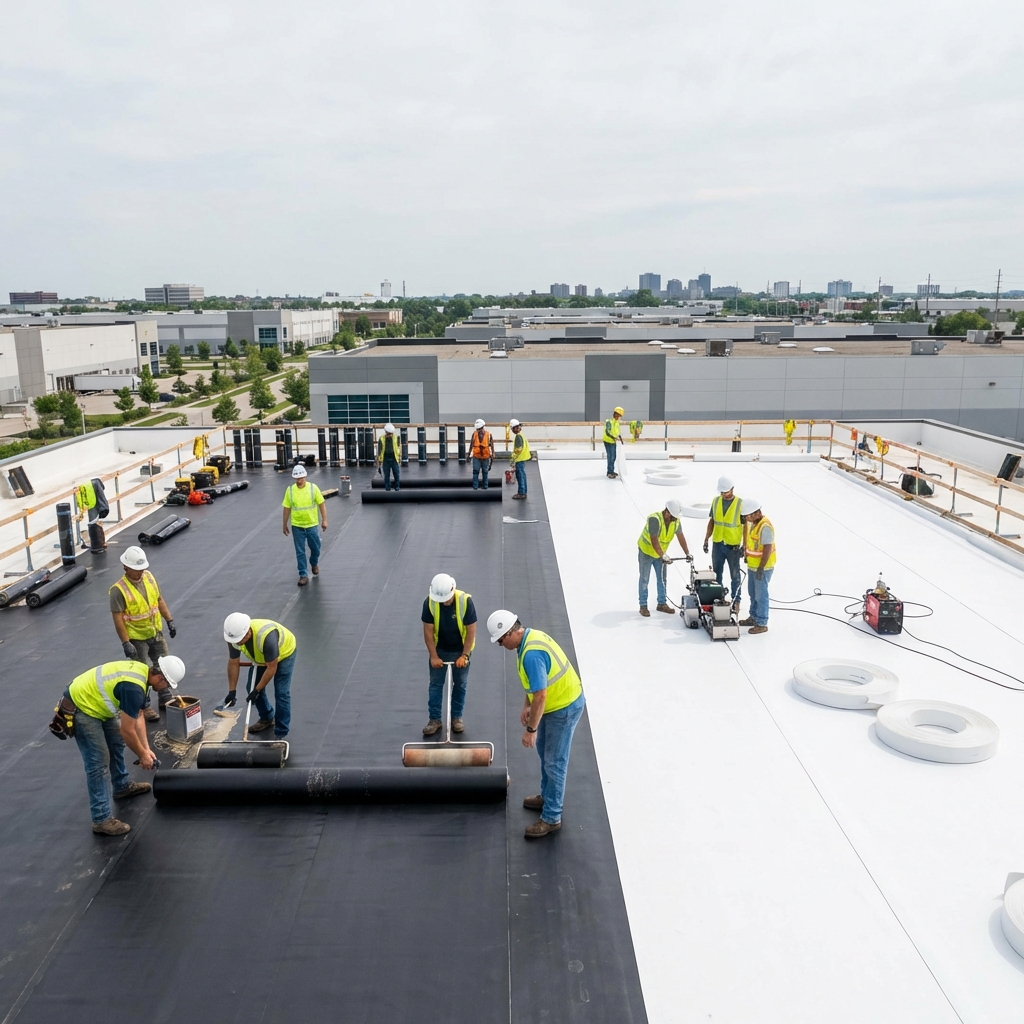
We invest in training and equipment because installation quality directly affects your roof’s service life. A roof installed by our team is backed by our 15-year workmanship warranty, which means we’re financially committed to standing behind our work. That commitment drives our installation standards.
Your action: Ask any roofing contractor how they verify seam quality, what training their technicians hold, and whether they’ll warranty their workmanship for 10+ years. The answers reveal their confidence in installation standards. We welcome site visits and references from previous commercial clients who can speak to our installation quality.
Maintenance Requirements: What You Need to Know
Neither EPDM nor TPO is maintenance-free, though both require far less attention than older built-up tar-and-gravel roofs. Understanding your maintenance obligations helps you budget appropriately and prevents small problems from becoming expensive emergencies.
EPDM maintenance focuses on membrane protection and seam integrity. We recommend:
- Annual inspections: Walk the roof or use drone inspection to check for punctures, seam separation, or deterioration
- Debris removal: Clear leaves, branches, and standing water, which can trap moisture and damage the membrane
- Seam monitoring: Look for any lifting or separation in taped or glued seams, particularly around high-traffic areas
- Protective measures: Avoid placing heavy equipment directly on the membrane; use boards or protective covers if roof access is necessary
The good news: EPDM is forgiving of minor damage. Small punctures or seam separations are straightforward to repair using patch kits or liquid sealants. Most repairs cost under $500 and take a few hours.
TPO maintenance is similar but with some distinctions:
- Annual inspections: Same importance as EPDM; look for membrane damage or heat-weld separation
- Seam care: TPO’s heat-welded seams are more durable but can’t be patched with adhesive; any significant seam damage requires professional re-welding
- Debris management: Equally important; standing water risks exceeding TPO’s design tolerances
- Coating options: Some TPO installations benefit from protective coatings that extend membrane life and improve energy performance
We often recommend proactive roof coatings for both systems after 10-15 years of service. A quality coating refreshes the membrane’s UV protection, extends service life by 5-10 years, and costs a fraction of a full replacement.
The real maintenance advantage comes from choosing a roofing partner who’s available when problems arise. We maintain a rapid-response service program for our commercial clients, which means leaks are addressed within 24-48 hours rather than waiting weeks for contractor availability.
Your action: Establish a preventive maintenance schedule immediately after installation. We recommend twice-yearly inspections: spring and fall. Budget approximately $500-$1,500 annually for proactive maintenance. This investment prevents emergency repairs that can cost 5-10 times more.
Why Expert Exteriors is Your Best Choice for Commercial Roofing
We’ve been protecting Brookfield and surrounding commercial properties for years, and that experience informs every decision we make. We’re not a national roofing franchise; we’re local experts who understand Wisconsin’s climate, local building codes, and the specific challenges commercial properties face in our region.
When you work with us on your commercial roofing services, you’re getting genuine expertise, not a sales pitch. We don’t have a quota pushing us toward one system or another. We listen to your operational priorities, your budget constraints, and your long-term goals, then recommend the solution that actually serves you best. Sometimes that’s EPDM; sometimes it’s TPO. We’ll tell you honestly which makes more sense for your building.
Our commitment to quality extends through every phase:
- Detailed site assessment: We evaluate your specific roof conditions, building usage patterns, climate exposure, and operational needs before proposing a solution
- Transparent pricing: You receive detailed quotes explaining material costs, labor, timeline, and warranty coverage. No hidden fees or surprise charges
- Expert installation: Our crews are trained, certified, and held accountable for workmanship quality through our 15-year warranty
- Ongoing support: After installation, we’re available for inspections, maintenance, and any repairs your system may need
We also understand that commercial roof replacement is a significant capital investment. We work with property managers and owners to schedule work around your operational calendar, minimize business disruption, and sometimes coordinate financing to make the project more manageable.
When you need flat and low-slope roofing solutions, you need a contractor who understands both the technical specifications and the business implications. That’s exactly what we provide.
Your action: Contact us for a free commercial roofing assessment. We’ll inspect your current roof, discuss your business priorities, and provide a detailed recommendation with realistic timelines and costs.
Real Results: Case Studies from Brookfield Area Businesses
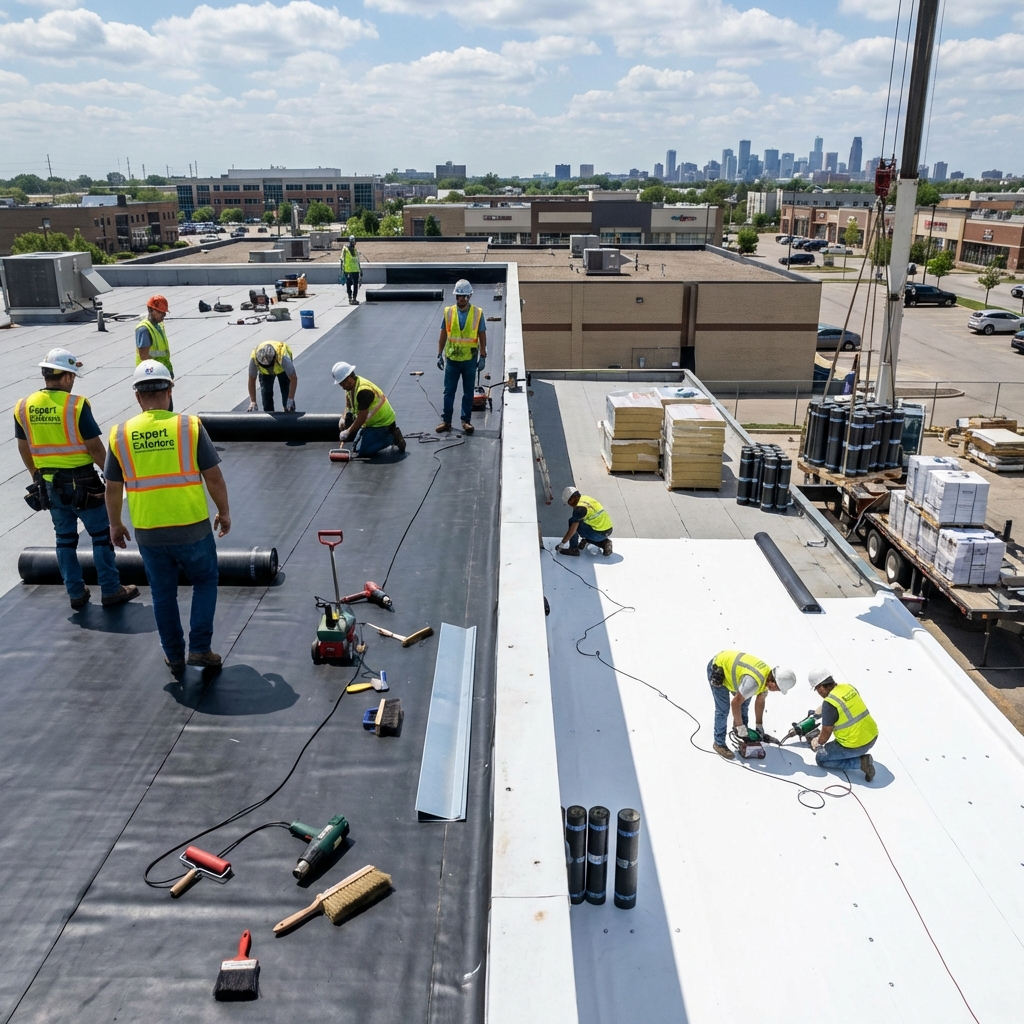
Theory is useful, but results speak louder. Let us share how EPDM and TPO have performed for real Brookfield businesses.
Case Study 1: Manufacturing Facility (EPDM Selection)
A local manufacturing operation needed roof replacement on their 15,000-square-foot facility. They had minimal cooling demands (production equipment generates substantial heat), operated 24/7, and prioritized cost control and long-term durability. Their facility experiences significant temperature fluctuations due to the nature of manufacturing processes.
We specified EPDM based on these operational characteristics. The lower upfront cost aligned with their budget, and the rubber membrane’s flexibility made it ideal for a building experiencing constant thermal stress. Five years into service, the system remains performing flawlessly with minimal maintenance costs. The facility manager reports virtually no roof-related issues and appreciates the straightforward repair process when occasional minor maintenance is needed.
Case Study 2: Office Building (TPO Selection)
A professional services office occupying 20,000 square feet faced significant cooling costs during summer months. Building management prioritized energy efficiency as part of their sustainability initiatives and wanted to reduce operational expenses. The facility had extensive roof exposure with minimal shading.
We installed a white TPO system with complementary insulation upgrades. The first-year cooling cost reduction exceeded projections by approximately 12%. Within six years, the energy savings fully paid for the TPO system’s cost premium compared to EPDM. Beyond financial performance, the building’s sustainability profile improved measurably, which management uses in their marketing to attract environmentally conscious clients.
More case studies and detailed project information are available in our case studies section, where you can see actual results from similar commercial properties.
Your action: Review projects in your service area to see what systems we’ve specified for comparable buildings. Reach out to those property managers and ask about their experience; most are happy to share candid feedback.
Getting Started with Your Commercial Roof Replacement
If your building is approaching the end of its current roof’s service life, or if you’re experiencing persistent leaks or maintenance problems, now is the time to take action. The longer you wait, the higher the risk of emergency damage that forces hurried decisions and compromises quality.
Here’s how we typically work with commercial clients:
Phase One: Assessment and Recommendation (1-2 weeks)
We inspect your roof, review building records and maintenance history, evaluate your operational requirements, and assess local climate factors. We then provide a detailed written recommendation including system options, energy performance projections, expected lifespan, maintenance requirements, and transparent pricing. You’re armed with complete information before committing to anything.
Phase Two: Planning and Preparation (2-4 weeks)
Once you’ve selected your preferred system, we develop a detailed installation schedule that minimizes disruption to your operations. We coordinate access, identify any areas requiring special handling, and ensure all materials are on-site before work begins. We’re respectful of your business; planning prevents chaos.
Phase Three: Installation (1-3 weeks depending on complexity)
Our crews execute the installation using the quality standards we’ve outlined throughout this article. We provide regular updates, address any issues immediately, and maintain a clean work site. Most clients are pleasantly surprised by how smoothly the process proceeds when preparation is thorough.
Phase Four: Warranty and Ongoing Support (20+ years)
Your roof doesn’t need attention only immediately after installation. We schedule post-installation inspections, maintain documentation for warranty purposes, and remain available whenever you have questions or need service.
Getting started is straightforward: contact us with basic information about your building (square footage, current roof condition, primary concerns). We’ll schedule a time that works with your schedule and begin the assessment process. There’s no obligation or pressure; we’re genuinely interested in helping you make the best decision for your specific situation.
Your commercial property’s roof is one of your most critical assets. It deserves expertise, quality, and a contractor who’s genuinely invested in your long-term success. That’s what we deliver.