

Top 5 Best Practices for Minimizing Tenant Disruption During Multi-Family Roof Replacements
Understanding the Challenge of Multi-Family Roof Projects
Multi-family roof replacements present a complexity that single-family projects simply don’t face. When we work on an apartment complex or multi-unit residential building, we’re not just managing weather, materials, and timelines. We’re coordinating around dozens or hundreds of people’s daily lives, schedules, and expectations.
The stakes feel higher because they are. A disrupted tenant might file complaints with management, leave negative reviews, or worse, threaten legal action if work interrupts their access or creates unsafe conditions. Property managers shoulder the burden of managing resident frustration while trying to protect their building’s long-term structural integrity. That tension between urgency and sensitivity defines every multi-family roofing project we undertake.
What separates our approach from standard roofing contractors is recognizing that tenant disruption isn’t just a side effect of the work. It’s a primary consideration that shapes how we plan, communicate, and execute every phase.
How We Prioritize Tenant Communication and Planning
We start before we ever bring a ladder or nail gun on-site. Our first step involves meeting with property management to establish a communication protocol that works for their specific community. Some buildings prefer weekly emails to all residents. Others want door-hangers with daily notifications. A few multi-unit complexes request that we hold a tenant information session before work begins.
We don’t impose a one-size-fits-all approach because different communities have different cultures and needs. A building with mostly retirees may benefit from a more detailed, advance notice strategy. A younger, transient population might prefer brief, daily updates. We adapt.
For each project, we develop a Tenant Impact Summary document that clearly outlines:
- Exact dates when work will occur (and backup dates for weather)
- Specific times when we’ll be noisiest (typically 8 AM to 3 PM on weekdays)
- Which areas of the building will be affected each day
- Parking or access restrictions, if any
- Emergency contact information for questions or problems during work
This document gets distributed at least two weeks before the first nail is driven. Transparency here eliminates surprises, which are the primary source of tenant frustration.
Our internal project coordinator also schedules a pre-project call with property management exactly one week before we mobilize. During that call, we review any last-minute concerns, confirm building access procedures, and confirm whether additional equipment or protection measures are needed for particular units.
Action step: If you’re a property manager preparing your building for roof work, request this communication plan in writing before hiring any contractor.
Our Pre-Project Coordination Approach
Before our crews arrive, we conduct a detailed site survey with property management to identify potential pinch points. Are there ground-level balconies where debris might fall? Which elevator or stairwell gets the heaviest tenant traffic? Where will trucks block natural light or entry paths?
We also identify critical tenant situations that warrant extra consideration. Buildings often house elderly residents, families with very young children, individuals working night shifts or from home, and sometimes tenants with documented medical sensitivities to noise or dust. Property managers share these details with us confidentially, and we build contingency plans around them.
Our crew uses drop cloths and containment systems on the ground to catch debris before it scatters across landscaping, parked cars, or tenant outdoor spaces. We position equipment and dumpsters to minimize the footprint of our staging area. In some cases, we’ve coordinated with local parking to reserve temporary spots near the building so we’re not consuming tenant parking throughout the project.
We also sync with building maintenance staff. They know the roof better than anyone. They understand load capacity, drainage patterns, and where structural concerns exist. Their insights help us refine our access routes and equipment placement to avoid stressing the building systems.
Each phase of preparation gets documented in our pre-project report, which we share with management. This isn’t just due diligence. It demonstrates that we’ve thought carefully about their building and their residents, which builds confidence before day one.
Action step: Request a detailed pre-project site survey and a written coordination plan showing how the contractor has identified and mitigated specific disruption risks for your building.
Scheduling Strategies That Protect Tenant Access
The timeline itself becomes a strategic tool for minimizing disruption. We never schedule multi-family roof work during spring break, summer vacation peaks, major holidays, or back-to-school periods when residential turnover is highest and emotions run high. We also avoid scheduling directly before or after rent day when tenant stress levels tend to spike.
For most multi-family projects, we compress the schedule into 3 to 5 continuous days rather than spreading work across weeks. The math is simple: one intense week of noise and activity causes less cumulative disruption than picking at the project over six weeks with frequent start-and-stop cycles. Residents can mentally prepare for a known, finite disruption. Prolonged uncertainty wears on people.
Within that compressed window, we stagger work phases to preserve tenant access to parking, common areas, and unit entries. For example, we might stage all rooftop removal and structural work on days one and two when we’re already causing maximum noise. Days three through five focus on installation and finishing, which is quieter and allows us to shift equipment off parking areas by mid-afternoon.
We also never schedule roof work on weekends unless we’ve received explicit written permission from property management and provided advance resident notice. Weekends are when residents are home, and the last thing families need is overhead roofing work during their personal time.
Our project managers build contingency time into schedules specifically for weather delays, which are common in the Wisconsin climate. Instead of pushing crews to work faster and sloppier when rain delays arise, we simply extend the timeline by one or two days. This keeps quality high and prevents the stress of compressed, rushed work that often increases disruption.
Action step: When getting bids, ask contractors for their exact project timeline and how they account for weather delays. Compressed, fixed schedules with contingency days protect tenants better than vague “weather permitting” language.
Our On-Site Management Practices to Reduce Noise and Disruption
Noise is the most persistent complaint during roof replacement, so we’ve invested in specific equipment and practices to minimize it. We use pneumatic nailers with noise-dampening mufflers instead of louder framing guns. Our crews hand-carry materials up scaffolding rather than using loud hoist systems when feasible. We position air compressors away from windows facing occupied units.
We also implement a “quiet hours” protocol after 3 PM on weekdays. After that time, we focus on non-impact work: installation, sealing, cleanup, and prep for the next day. If impact work must occur late, we schedule it only on our first or second day when noise expectations are already set.
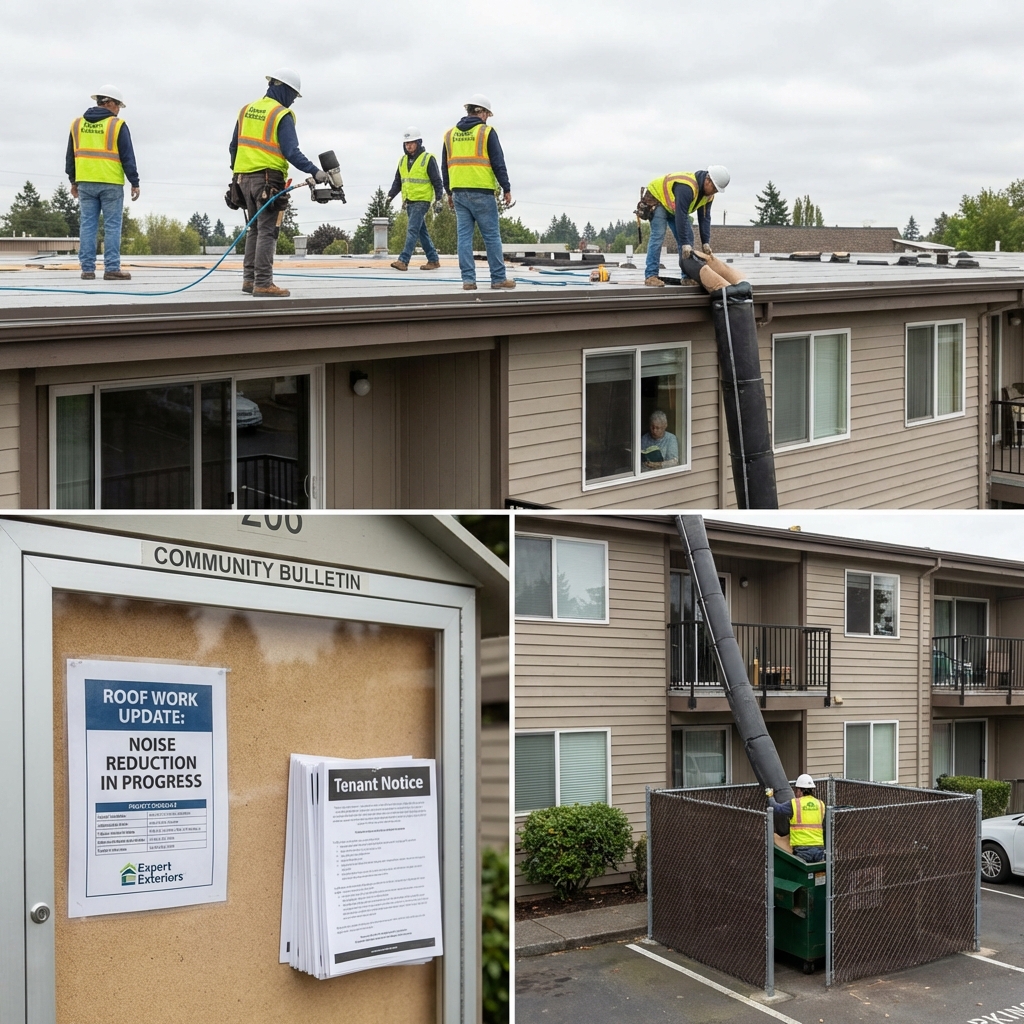
Dust control deserves equal attention. We use wet sweeping and misting systems to suppress dust from the roof surface, particularly during old shingle removal. Fine particles can drift down multiple stories and irritate residents, especially those with respiratory sensitivities. Our containment tarping also prevents airborne debris from entering windows and balconies.
Our on-site crew chief is positioned at the building entrance or main office during business hours. Residents or property staff can immediately flag any issues: a ladder blocking a unit door, debris in a specific area, unexpected noise. We respond within minutes, not hours. Quick response to problems prevents small frustrations from festering into bigger complaints.
We also establish a clear debris removal schedule. Dumpsters get emptied at the end of each day, and ground areas get swept before residents return from work in late afternoon. The building doesn’t look like a construction zone at 5 PM, even though it does at 8 AM.
Action step: When contracting, specify that your building receives a dedicated on-site project manager during work hours who can respond immediately to tenant issues.
Quality Workmanship Without Extended Timelines
The temptation during multi-family projects is to cut corners or rush through quality checks to minimize disruption time. We do the opposite. We’d rather extend a timeline by one day to inspect flashing properly than rush and create leaks that require emergency service callbacks weeks later.
Our crews are experienced in the specific demands of multi-family work. They understand that climbing stairs to access rooftop staging areas all day is physically demanding, and we staff crews appropriately so fatigue doesn’t trigger safety issues or poor workmanship. We also rotate our most experienced crew members onto multi-family projects. Seasoned roofers work faster and cleaner because they’ve solved every problem before.
We use premium materials consistently, not budget options. When we install TPO or EPDM roofing systems, we specify quality grades that deliver longevity. When we flash penetrations and edges, we use materials and techniques rated for commercial durability. A faster-installed but lower-quality roof means problems emerge within years, requiring re-work that compounds disruption.
Our roof replacement services come with a 15-year workmanship warranty precisely because we stand behind the integrity of what we install under schedule pressure. That warranty reflects our confidence that we’re not sacrificing durability for speed.
Documentation matters too. Our crews photograph their work at multiple phases. We create a post-project report with photos showing the completed work, material certifications, and warranty details. Property managers receive this documentation, which protects them and gives residents visibility into what was done.
Action step: Verify that any roofing contractor offers a workmanship warranty and provides photo documentation of completed work before you sign the contract.
Waste Management and Property Protection Systems
Debris management defines the day-to-day tenant experience more than most property managers realize. Stray nails, shingle fragments, flashing scraps, and tar paper pieces scatter if you don’t have a rigorous collection system.
Our crews use ground tarps that extend 15 feet from the building perimeter during tear-off phases. We assign one crew member specifically to debris sweeping and material collection during peak removal hours. We also use magnetized brooms to catch ferrous metal debris before it becomes a tenant safety hazard.
We position dumpsters to catch falling debris whenever possible and use netting to prevent materials from shifting across driveways or parking areas. For buildings with particularly sensitive layouts, we use elevated tarps on the ground level to create a catch system that prevents any debris from reaching landscaping, vehicles, or walkways.
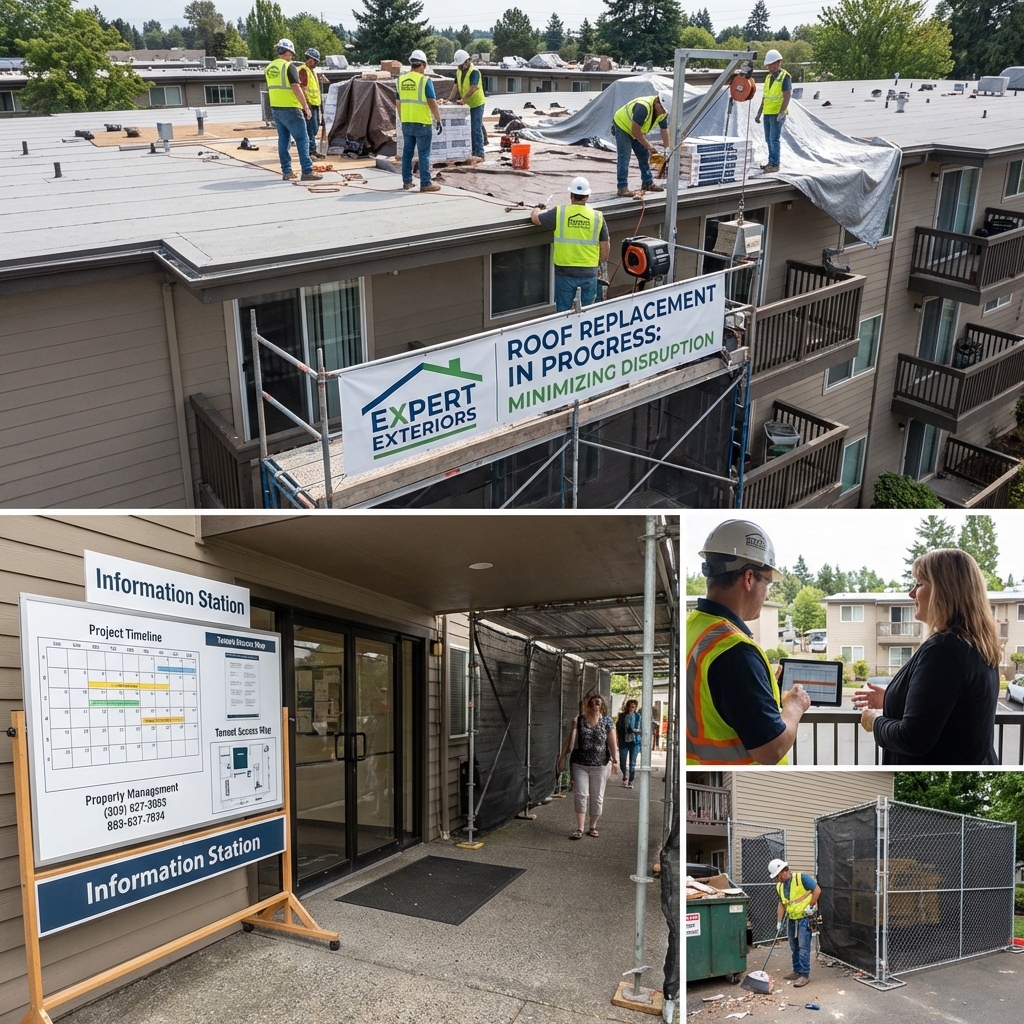
Gutters and fascia protection also gets special attention during roof work. We protect existing gutters and soffit systems with temporary shielding during roof removal so that our work doesn’t damage systems we’re not replacing. If we’re replacing those elements, we coordinate the order of work so tenant access stays clear.
We also conduct a final property walkthrough with management on the day we finish, inspecting parking areas, common spaces, balconies, and building perimeter. We physically pick up any stray fasteners or debris our crews might have missed. No property leaves our responsibility without a clean inspection.
Action step: When contracting roofing work, require a detailed debris management plan in writing, including dumpster placement, ground protection, and a final cleanup walkthrough before final payment.
Why Our Process Outperforms Standard Roofing Methods
Standard roofing contractors often treat multi-family projects like scaled-up single-family work. They show up with a crew, work fast, and leave. Tenant communication is an afterthought. Debris management is whatever the crew remembers to do. Schedule compression happens ad-hoc, not by design.
We’ve structured our entire approach around the realities of managing occupied buildings. Our project coordinators don’t just schedule roofing work. They manage stakeholder relationships, anticipate friction points, and build systems that prevent disruption before it happens.
That commitment also extends to how we price work. We charge appropriately for the complexity of multi-family coordination because we staff projects properly and invest in equipment and practices that standard crews skip. The lowest price you’ll find is usually the contractor who isn’t planning for these realities.
Our commercial multi-unit roofing experience means we’re comfortable with larger scope, longer buildings, and buildings with higher visibility and occupancy. We’ve worked in Brookfield and surrounding communities long enough to understand local tenant expectations and municipal requirements.
We also reference a portfolio of completed multi-family projects with written testimonials from property managers. If a contractor can’t show you comparable projects with documented outcomes, that’s a red flag. Multi-family work is different, and you want someone with proven expertise.
Action step: Request references from at least three completed multi-family roofing projects from any contractor you’re considering. Call those references and specifically ask about tenant communication quality and actual disruption experienced.
Expert Exteriors: Your Solution for Seamless Multi-Family Projects
We understand that multi-family roof replacement isn’t just a construction project for property owners and managers. It’s a logistical challenge that touches every resident’s quality of life for the duration of the work. Handled well, tenants barely notice the project. Handled poorly, it becomes a nightmare of complaints, documentation, and stress.
That’s why we’ve built our entire multi-family roofing capability around minimizing disruption while delivering durable, warrantied results. From the pre-project communication protocol through the final debris walkthrough, every practice we’ve outlined reflects decades of learning what actually matters to residents and managers.
When you contract with us for your roof replacement services, you’re hiring a team that has worked on hundreds of multi-family buildings. We’ve handled everything from modest six-unit complexes to large commercial properties. We know how to coordinate with building systems, work safely at heights with nearby occupied units, and deliver results without creating neighborhood controversy.
We’re ready to bring our expertise to your building. Contact us to schedule a site assessment and receive a detailed project plan that shows exactly how we’ll protect your tenants while protecting your property.